Most software products fail before they reach real users. Not because the idea was bad, but because the team spent six months building the wrong things.
The cause is almost always the same. Founders treat their first product like it needs to be complete. They add features "just in case," polish screens nobody has tested, and build integrations for users they have not yet found. By the time they launch, they have spent their budget on assumptions instead of answers.
An MVP, done right, flips this. You build the minimum needed to put a real product in front of real users and learn something valuable. The goal is not to impress. The goal is to find out if your core idea actually works.
What an MVP Actually Means
MVP stands for Minimum Viable Product. The word people get wrong is "viable." It does not mean barely functional. It means capable of delivering enough value that a real user would choose to use it over doing nothing.
A landing page with a sign-up form is not an MVP. A spreadsheet your team fills out manually is a workaround, not a product. An MVP is a real, working product with a very focused scope.
| Prototype | MVP | Full Product | |
|---|---|---|---|
| Purpose | Visualize the idea | Test the core assumption | Serve the full market |
| Users | Internal or demo only | Real paying or active users | All target segments |
| Features | Visual mockup | Core workflow only | Full feature set |
| Typical Build Time | Days to 2 weeks | 6 to 14 weeks | 6 to 18 months |
| Financial Risk | Very low | Medium | High |
The Three Questions Your MVP Must Answer
Before a single line of code gets written, your MVP needs to be built around three questions:
- Who is this for, specifically?
- What problem does it solve for them, precisely?
- Why would they pick this over what they do today?
If you cannot answer all three clearly and specifically, you are not ready to build. The MVP is a tool for testing your answers, not for exploring every feature you have imagined.
The MVP Development Framework
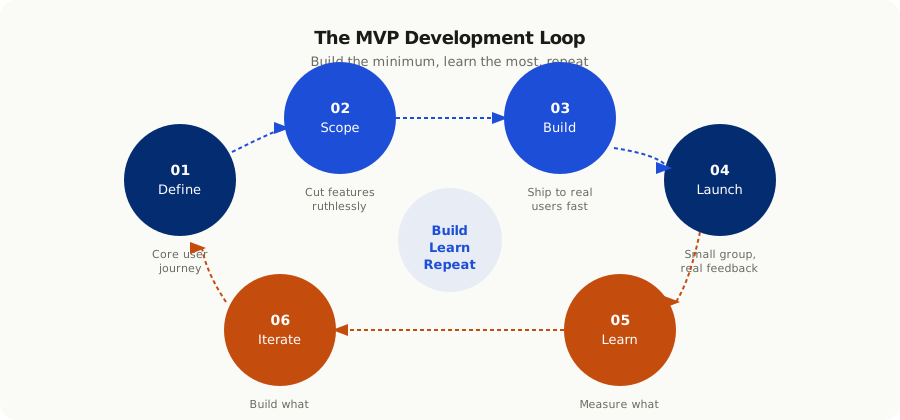
Stage 1: Define the core user journey
Pick one type of user and one task they need to complete. Not five user types and fifteen tasks. One. Map every step they take from arriving at your product to getting the result they came for.
Everything outside that single journey is out of scope for the MVP. Write it down and treat it as a rule, not a suggestion.
Stage 2: List and rank your assumptions
Your idea depends on assumptions. Write all of them down. For example:
- Users will pay a certain amount per month for this
- The biggest pain point is one specific thing, not another
- Users are willing to switch away from the tool they use today
Rank them by risk. An assumption that breaks your entire business model if wrong is more dangerous than an assumption about a secondary feature. Your MVP exists to test the riskiest ones first.
Stage 3: Find the minimum feature set
Go through every planned feature and ask one question: "Does removing this break the core user journey?" If not, cut it. Features outside the core journey can always be added later. They cannot be unbuilt if they turn out to be wrong assumptions.
The best MVP is the one that gets your core idea in front of real users the fastest. Not the most polished one, not the one with the most integrations, and not the one that covers every edge case. Speed to validation is the metric that matters.
Stage 4: Choose technology that favors speed
Your MVP technology choices should prioritize how fast your team can ship, not how well the system will handle a million users. You are not building for scale yet. You are building to find out if anyone wants this at all.
This does not mean cutting corners on security or picking tools nobody on your team knows. It means using well-understood frameworks with good defaults so you spend time on product decisions, not infrastructure ones.
Stage 5: Build, measure, learn, repeat
The feedback loop is the product at this stage. Build the MVP, put it in front of real users, watch what they actually do (not what they say they would do), and use that information to make your next call. That call might be to build more, to change direction, or in some cases, to stop entirely.
What to Include and What to Cut
This is where most MVPs go wrong. Here is a practical filter:
| Include in the MVP | Cut from the MVP |
|---|---|
| Core user workflow | Onboarding tour |
| The one essential action | Profile customization |
| Basic data your team needs | Analytics dashboards |
| Simple login and access | Social login, SSO |
| One notification type | Email marketing tools |
| Payment for a single plan | Multiple pricing tiers |
Admin panels, settings pages, notification preferences, and reporting features are almost never needed in an MVP. Your team can handle these manually at first. Manual processes are a feature of early products, not a flaw.
The Real Cost of Building an MVP
MVP budgets vary widely depending on what you are building. Here is a realistic range based on product type and team quality:
| Product Type | Typical Timeline | Realistic Cost Range |
|---|---|---|
| Simple web app (basic CRUD) | 6 to 8 weeks | $8,000 to $20,000 |
| Consumer mobile app | 8 to 12 weeks | $15,000 to $40,000 |
| B2B SaaS platform | 10 to 16 weeks | $25,000 to $70,000 |
| Two-sided marketplace | 12 to 20 weeks | $40,000 to $100,000 |
| AI-powered product | 10 to 18 weeks | $30,000 to $80,000 |
These ranges assume an experienced team. Cheaper is not always better. A poorly built MVP that teaches you nothing costs more in the long run than a well-built one that answers your key questions quickly.
The Most Common MVP Mistakes
Building too much
The most frequent mistake by a wide margin. Founders add features because they worry users will ask for them. Each extra feature adds cost, build time, and complexity. It also blurs your signal. If you launch with twenty features and users leave, you do not know which features let them down.
Skipping user conversations before building
Build something for real, specific people, not imagined ones. Before you finalize your scope, talk to ten or fifteen potential users. What they tell you will surprise you and save you weeks of work building the wrong thing.
Treating the MVP as a public product launch
An MVP is a research tool. It will have rough edges, limited features, and possibly a few bugs. Sharing it with a small group of target users is fundamentally different from a public launch. Keep your own expectations calibrated accordingly.
Not defining success before you start
If you do not decide what success looks like before you build, you will not know what to measure after you launch. Pick two or three metrics that directly reflect your core assumption. Watch those and nothing else at first.
Keeping developers and business stakeholders separate
Development teams that work without product or business input make technical decisions that conflict with business goals. Someone with product context needs to be part of daily decisions throughout the build, not just at kickoff and at review.
How to Know Your MVP Is Ready to Test
Your MVP is ready when:
- A new user can complete the core journey without guidance from your team
- The core assumption can actually be tested with the current feature set
- You have ten to twenty real users ready to give honest feedback
- You have defined in writing what success and failure look like
It is not ready because it has every feature on your list, the design looks perfect, or it handles every edge case smoothly.
Choosing the Right Team
You have three main options: build it yourself, hire freelancers, or work with a development agency or partner.
Building yourself is the lowest cash cost if you have strong technical skills, but the slowest path if you do not. Freelancers offer flexibility but require real management effort to coordinate well. A development agency brings a structured team and process, at a higher upfront cost but usually with significantly lower coordination overhead.
For founders without a technical background, working with an experienced team tends to produce better outcomes faster than managing multiple freelancers. The management time you save is worth more than the cost difference in most cases.
At Angrio, we work with founders to move from whiteboard sketch to working MVP in as little as eight weeks. The products that reach users successfully are not the ones with the biggest budgets. They are the ones that test their core assumption the fastest, with the right team behind them.
After the MVP: What Comes Next
Launching the MVP is not the finish line. It is the start of the actual work. After you put it in front of users:
- Talk to early users directly, not just through usage data
- Look for patterns in who uses the product, who stays, and who leaves
- Prioritize your next features based on what you learn, not what you planned before you had data
- Refactor or rebuild only when the current approach is genuinely blocking progress
If your MVP validates your core assumption, you build more. If it does not, you change direction with far less lost than if you had built a full product first. That is the entire point of starting small.