Every software project begins with an architecture decision that shapes everything that follows. Monolith or microservices? Most development teams have a strong opinion, but the honest answer is: it depends. The right architecture for your project depends on your team size, product maturity, and actual scaling needs. Not on what a major tech company published in a blog post four years ago.
This guide gives you a clear framework for making the decision, without the hype.
What is a Monolith?
A monolith packages all parts of your application into a single deployable unit. The user interface, business logic, and database access layer live together in one codebase. When you deploy, you deploy everything at once.
This sounds like a limitation, but it is actually a strength for most products at early stages. The entire application shares memory, function calls are direct, and there are no network hops between components. A bug shows up in a single stack trace. A deployment is a single command.
Companies like Shopify, GitHub, Stack Overflow, and Basecamp built large, successful products on monolithic codebases. Shopify served billions in transactions before beginning any decomposition. A monolith is not a failure to plan ahead. It is a deliberate engineering choice.
What are Microservices?
Microservices split your application into small, independently deployable services. Each service handles one specific business function, maintains its own database, and communicates with other services over a network, typically through REST APIs or message queues.
An e-commerce platform using microservices might have separate services for user accounts, product catalog, inventory, order management, payments, and notifications. Each service is deployed independently, maintained by its own team, and can be updated without touching anything else.
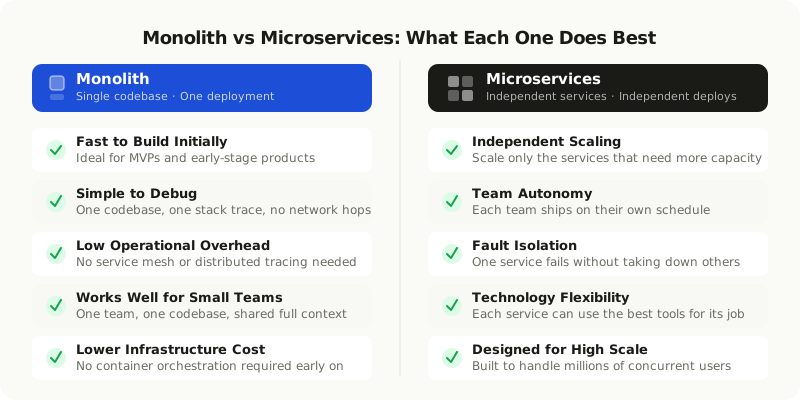
The benefits of microservices are real: independent deployments reduce release risk, independent scaling cuts infrastructure costs, and team autonomy speeds up development at large organizations. But these benefits only appear when the conditions are right.
How They Compare Side by Side
| Factor | Monolith | Microservices |
|---|---|---|
| Deployment | Single unit, all at once | Per-service, independently |
| Scaling | Scale the entire app | Scale only what needs it |
| Team structure | Works well for small teams | Designed for larger, distributed teams |
| Initial development speed | Faster | Slower (more setup required) |
| Operational complexity | Low | High |
| Debugging | Single stack trace | Requires distributed tracing tools |
| Data management | Shared database | Per-service databases |
| Fault isolation | Low: one crash can affect all | High: failures stay contained |
| Technology flexibility | One stack | Each service can use its own |
| Infrastructure cost | Lower early on | Higher (more moving parts) |
When a Monolith is the Right Choice
A monolith is the better architecture in more situations than the tech industry typically acknowledges.
**You are building an MVP or validating a product idea.** Speed and iteration velocity matter most at this stage. A monolith lets you move fast, reorganize code freely, and test ideas without the overhead of managing distributed services. If your product does not find market fit, you will not have wasted months building microservice infrastructure for something that gets rewritten anyway.
**Your team has fewer than ten engineers.** Microservices introduce coordination overhead. With a small team, that overhead eats into the time you should be spending on product. Small teams get more done with a single codebase they all understand deeply.
**Your requirements are still changing frequently.** Microservices work best when service boundaries are clearly defined. When you are still figuring out what your product should be, drawing service boundaries too early locks you into decisions that may be wrong. A monolith lets you move code around freely as your understanding of the problem deepens.
**You have limited DevOps capacity.** Microservices require infrastructure for service discovery, API gateways, inter-service authentication, container orchestration, distributed logging, and distributed tracing. If no one on your team has experience running that kind of infrastructure, the complexity cost is very high.
**Budget is a real constraint.** Running 12 independent services on Kubernetes costs significantly more than running one well-designed application. For startups and early-stage products, the infrastructure savings from a monolith are meaningful and should not be ignored.
When Microservices Make Sense
There are situations where microservices deliver genuine value that is worth the added complexity.
**Different parts of your system scale at very different rates.** If your search service handles 500 requests per second and your user management service handles 5, scaling the entire monolith to handle search traffic wastes significant infrastructure spend. Microservices let you scale only the components that need it.
**Multiple teams need to work independently.** When 40 engineers push to the same codebase, deployments become high-risk events. A breaking change in one module can block everyone else's work. Independent services give teams genuine autonomy to ship on their own schedules without coordinating every release.
**Fault isolation is a product requirement.** A payment processing failure should not prevent customers from browsing your product catalog. In a monolith, a memory leak or uncaught exception in one area can bring down the entire application. Microservices contain failures within defined boundaries.
**You need technology flexibility.** A data science team building a recommendation engine may work best in Python with machine learning libraries while the rest of your engineering team runs Node.js or Go. Microservices allow each team to use the tools that are genuinely best for their specific problem.
The companies that benefit most from microservices share a common profile: large teams, clear domain boundaries, real scaling pressure, and mature DevOps practices. If any of those are missing, the overhead of microservices will outweigh the benefits.
The Middle Ground: Modular Monolith
The modular monolith has gained significant attention in recent years, and for good reason. It is a single deployable unit where the internal codebase is organized into clearly defined modules with strict boundaries.
Each module owns its own logic and data layer. Modules communicate through well-defined internal interfaces, not network calls. The result is a codebase that is much easier to understand and maintain than a tangled monolith, without the operational complexity of microservices.
Many engineering teams use the modular monolith as a productive middle ground. They build with clear module boundaries from the start, then extract individual modules into standalone services only when there is genuine scaling pressure or team autonomy justification.
This is a particularly smart approach for growing startups. You start simple, maintain speed, but build the structural foundations that make future decomposition manageable rather than chaotic.
Signs Your Monolith Has Outgrown Itself
Migration from monolith to microservices should be driven by real operational pain, not by trend or preference. Watch for these signals:
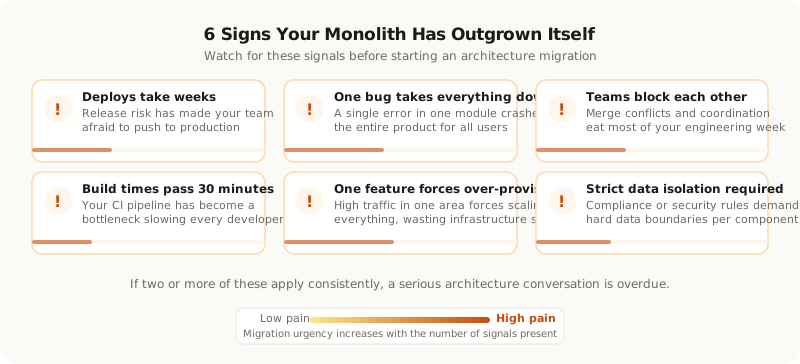
- Deployments have slowed to once a week or longer because the risk of breaking something is too high
- A single bug in one feature has repeatedly taken down the entire product for all users
- Different engineering teams are constantly blocked by each other's changes and merge conflicts
- Build times have grown past 20 to 30 minutes, slowing down every developer's feedback loop
- One high-traffic component is forcing you to over-provision infrastructure for the entire application
- Compliance or security requirements demand strict data isolation between specific components
If two or more of these apply consistently to your product, the conversation about architectural change is worth having seriously.
How to Make the Call
When making the architecture decision, answer these three questions honestly:
**What is your team size today, and what is realistic in the next 12 months?** Under ten engineers points strongly toward monolith. Over 30 engineers split across distinct product areas suggests microservices are worth evaluating for those specific areas. Between 10 and 30, a well-structured modular monolith is usually the best answer.
**Where is your product in its lifecycle?** Pre-product-market-fit always points to monolith. Post-PMF with genuine scaling pressure points to evaluating specific bottlenecks before making a blanket decision to migrate. At scale with clear team and domain boundaries, targeted microservices extraction makes sense.
**Do you have the DevOps bandwidth to run distributed systems safely?** Microservices without proper tooling for containerization, orchestration, observability, and per-service CI/CD create more problems than they solve. This is not optional infrastructure. It is the baseline cost of running microservices reliably in production.
Migrating Without Blowing Up Your Product
If your monolith has outgrown itself, avoid the big-bang rewrite. Extracting everything at once is how migrations turn into multi-year disasters that stall product development and exhaust engineering teams.
Use the Strangler Fig pattern instead. Build the new service alongside the existing monolith. Route a small portion of traffic to it. Validate that it works correctly in production. Then gradually increase traffic to the new service and retire the corresponding code in the monolith. One service at a time.
Start with the component that has the clearest business boundary, the most pressing scaling need, or the most independent team working on it. Prove the pattern works for that one service before expanding the approach.
The Bottom Line
Monolith or microservices is not a question of which is more modern or more sophisticated. It is a question of which architecture matches your current team size, product maturity, operational capabilities, and scaling needs.
Start with a well-structured monolith. Keep your modules clean and your boundaries clear from day one. Pay attention to the warning signals. Extract services when you have genuine operational justification, not before.
Most products that succeed long enough to genuinely need microservices started as monoliths. Architecture is a means to an end. Ship great software first.