Your software team ships an update on a Wednesday afternoon. By Thursday morning, half your users cannot log in. Two days later, after a weekend of scrambling, the team finds the problem and fixes it.
Sound familiar? This kind of story is very common. And in most cases, the root cause is not bad developers. It is a broken process.
DevOps exists to fix that process. But the word gets thrown around so often, in so many different contexts, that most business leaders have no idea what it actually means or whether they need it.
This guide explains DevOps in plain English. No jargon, no theory. Just a clear explanation of what it is, what it solves, and how to know if your team needs it.
What DevOps Actually Is
DevOps is not a tool you install. It is not a job title. It is not a department you create.
DevOps is a set of practices that bring your software development team (Dev) and your infrastructure and operations team (Ops) closer together, so they can build, test, and release software faster and more reliably.
The simplest way to understand it is through what happens when Dev and Ops are separated.
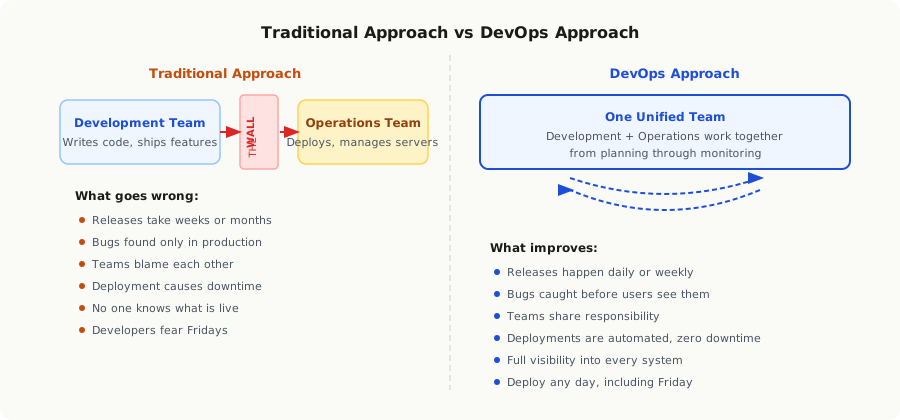
In a traditional setup, developers write code and then hand it to an operations team to deploy and manage. This handoff creates a wall between the two groups. Developers want to ship new features quickly. Operations wants systems to stay stable. These two goals pull in opposite directions, and the gap between them is where most software problems happen.
DevOps removes that wall. Both teams work with the same tools, the same processes, and the same goals. The result is software that ships faster and breaks less often.
The Problem DevOps Was Built to Solve
Before DevOps became common practice, this was the standard experience at most software companies:
A developer finishes a feature, writes it up, and passes it to a QA team for testing. Then it goes to an operations team for deployment planning. Then it gets scheduled for a monthly or quarterly release window. By the time that release happens, the code is weeks old, dozens of changes are bundled together, and nobody is quite sure what will break when it all goes live.
When something does break, the development team points at operations. Operations points back. Customers wait. The cycle repeats.
This was not inefficiency caused by bad people. It was a structural problem. Teams were organized to optimize their own work, not the flow of software to users. DevOps is the answer to that structural problem.
The Core Practices Inside DevOps
Understanding DevOps means understanding the few key practices that make it work. These are not complicated ideas, even if their names sound technical.
Continuous Integration (CI)
When developers write code, they merge their changes into a shared codebase multiple times a day. Each time they do, an automated process runs to build the software and test it. If something breaks, the team knows within minutes, not weeks.
This matters because bugs are cheapest to fix the moment they are introduced. The longer a bug sits undiscovered, the more code gets written on top of it, and the more expensive it becomes to untangle.
Continuous Delivery (CD)
Once code passes automated tests, it is automatically prepared for release. In some setups, it goes all the way to production with no human intervention. In others, a single click triggers the deployment.
The result is that releasing software stops being a stressful, high-risk event. It becomes routine. Teams that practice continuous delivery ship features in days, not months.
Infrastructure as Code (IaC)
Instead of manually configuring servers, databases, and networks through a web console or command line, infrastructure is described in text files, just like application code. Those files are stored in version control and can be reviewed, tested, and replicated.
This means a new environment that used to take a week to set up manually can be created in minutes. It also means every environment is consistent, which removes entire categories of bugs that come from differences between development and production.
Monitoring and Observability
DevOps teams instrument their software to track how it behaves in production. They collect logs, metrics, and error traces. They set up alerts so that when something goes wrong, the right person knows about it immediately, rather than finding out through customer complaints.
Good monitoring turns reactive firefighting into proactive maintenance.
The DevOps Lifecycle
DevOps is often visualized as a continuous loop because the work never stops. Each stage feeds directly into the next.
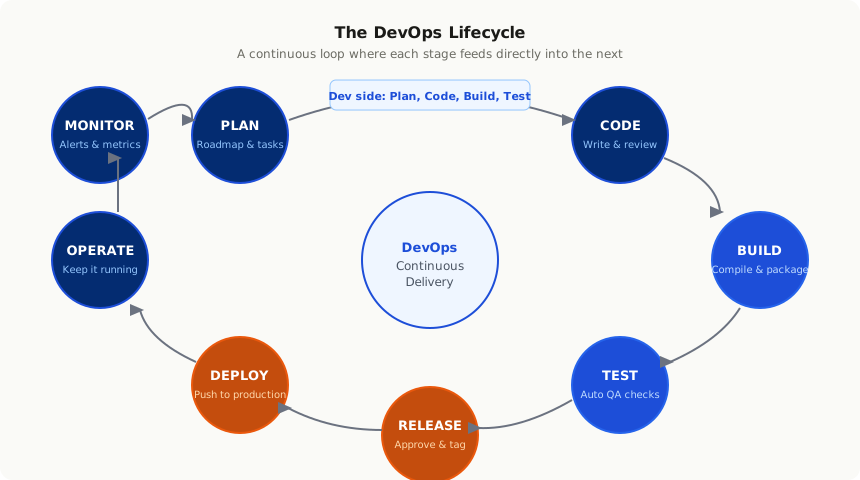
- **Plan:** Define what to build and why, using real data from the previous cycle.
- **Code:** Write and review the feature or fix.
- **Build:** Compile, package, and prepare the software automatically.
- **Test:** Run automated checks to catch bugs before they reach users.
- **Release:** Approve and tag the version for deployment.
- **Deploy:** Push the software to production, automatically or with one step.
- **Operate:** Keep the system running, handle scaling, manage infrastructure.
- **Monitor:** Collect data on how everything is performing and feed it back into planning.
The loop is the point. Traditional development processes were linear. You built something, shipped it, and came back later to fix it. DevOps makes improvement continuous, which means quality compounds over time instead of decaying.
The Business Benefits of DevOps
DevOps is ultimately a business decision, not just a technical one. Here is what it changes in real, measurable terms.
| Without DevOps | With DevOps | |
|---|---|---|
| Release frequency | Monthly to quarterly | Daily to weekly |
| Time to restore service after an incident | Hours to days | Minutes to hours |
| Deployment failure rate | 30 to 50 percent | Under 15 percent |
| Change lead time | Weeks to months | Hours to days |
| Developer time spent on manual tasks | High | Significantly reduced |
| Cost of fixing a production bug | Very high | Much lower (caught earlier) |
These numbers come from the DORA (DevOps Research and Assessment) program, which has tracked software delivery performance across thousands of organizations for more than a decade. The gap between high-performing DevOps teams and everyone else has only grown wider over that time.
Faster time to market
If your competitors can ship improvements every week and you ship every quarter, they accumulate twelve months of feedback and learning while you accumulate one. That gap compounds. It does not take long before a slower organization is genuinely behind in its product, not just in its process.
Lower cost of bugs
Research consistently shows that fixing a bug in production costs five to ten times more than fixing it during development. Automated testing and continuous integration mean most bugs are caught before they reach users at all. The ones that do reach production are identified faster and resolved more quickly.
Better developer experience
Developers who spend most of their time on manual deployment steps, environment debugging, and cross-team coordination are unhappy developers. DevOps practices automate the tedious parts and let engineers focus on building things. Teams with mature DevOps practices have measurably better retention than those without.
Predictable, reliable releases
A release event should not require the whole team to cancel their evenings. When deployment is automated and tested, it is boring in the best possible way. Boring deployments mean calm teams and reliable products.
7 Signs Your Team Needs DevOps
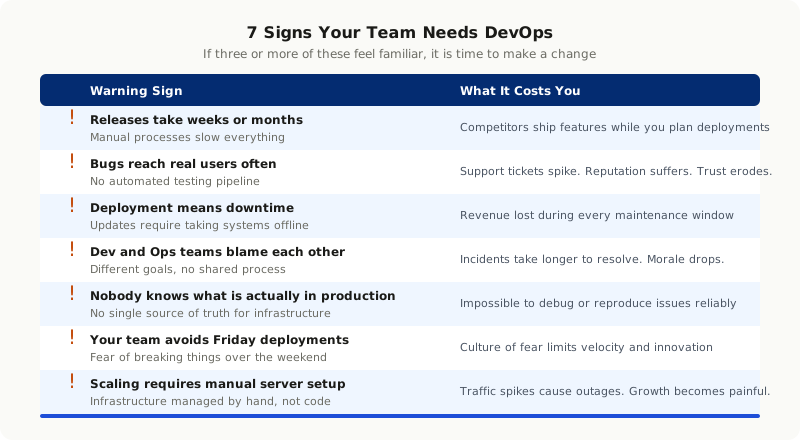
If your team recognizes itself in several of these patterns, it is not a people problem. It is a process problem.
**Your releases take weeks or months.** If getting a single bug fix into production requires scheduling, approval chains, and coordination across multiple teams, the process has too many friction points. Users cannot wait.
**Bugs frequently reach your users before your team catches them.** If you are regularly learning about problems from support tickets rather than from your own monitoring, you do not have enough automated testing in your pipeline.
**Deployment means downtime.** Modern deployments can be zero-downtime with the right infrastructure. If your users experience maintenance windows every time you update, that is not a technical limitation. It is a practice gap.
**Your development and operations teams blame each other when things go wrong.** This is almost always a sign that the two groups have different tools, different incentives, and different visibility into the same system. DevOps is the solution.
**Nobody on your team can say with confidence what is running in production.** If your infrastructure was set up manually over years, with no documentation and no reproducibility, you are one resigned engineer away from a serious problem.
**Your team avoids deployments on Fridays.** This is such a well-known symptom it has become a cliche. If your team is afraid of their own deployment process, that fear tells you everything you need to know about the state of the process.
**Scaling requires manual work.** If handling more traffic means someone manually adding servers and reconfiguring load balancers, you will always be a step behind demand. Infrastructure as code fixes this.
What DevOps Looks Like at Different Company Sizes
DevOps is not just for big technology companies. It scales down to small teams just as well, though what it looks like in practice varies.
Small teams (two to ten engineers)
At this size, the same engineers often do both development and infrastructure work. A basic CI/CD pipeline using a platform like GitHub Actions covers most of the value. Automated testing for the critical paths, one-command deployments, and basic uptime monitoring are achievable in a few weeks and make an immediate difference.
Growing teams (ten to fifty engineers)
As teams grow, the coordination cost of manual processes grows with them. This is when infrastructure as code becomes essential, when you need dedicated staging environments, and when monitoring needs to be more sophisticated. Teams at this size often benefit from a dedicated DevOps or platform engineer who sets up tooling and standards for everyone else.
Larger teams (fifty or more engineers)
At this scale, DevOps practices must be formalized. Multiple teams need to work independently without stepping on each other. This requires strong automation, service ownership models, detailed on-call practices, and investment in internal tooling. Large organizations that do this well ship more features with fewer incidents than small organizations that do it poorly.
The size of your team does not determine whether DevOps is worth pursuing. The cost of slow, unreliable software is the same regardless of headcount. A two-person startup and a five-hundred-person enterprise both benefit from shipping quickly and breaking things less often.
Common Myths About DevOps
**"We need to hire a DevOps engineer first."** You can start improving your process with your existing team. A dedicated DevOps engineer is valuable, but waiting for the perfect hire before starting means waiting indefinitely. Pick one manual process and automate it. Then the next one.
**"DevOps means eliminating the operations team."** It means combining responsibilities, not eliminating people. Operations engineers in a DevOps environment work on infrastructure automation, platform reliability, and internal tooling rather than manual deployment steps. Their work becomes more strategic, not less important.
**"DevOps only matters for big companies."** Startups and small teams often benefit more than large ones because the efficiency gains have a larger relative impact. A three-person team that deploys confidently and quickly is more competitive than a ten-person team paralyzed by process.
**"DevOps is just CI/CD."** CI/CD is one of the most visible DevOps practices, but DevOps also includes culture, monitoring, infrastructure management, security practices (sometimes called DevSecOps), and team organization. A CI/CD pipeline with no monitoring and no shared ownership is not DevOps.
How to Get Started
The biggest mistake organizations make when adopting DevOps is trying to transform everything at once. That approach stalls out under its own weight.
Start with the thing that hurts most right now.
If deployments are your biggest pain point, focus there first. Set up a basic automated deployment pipeline for your least critical service and learn from it before rolling it out more broadly.
If production bugs are your biggest problem, add automated testing to the workflows where failures have hurt you most. You do not need 100 percent test coverage. You need tests on the code that has already caused incidents.
If your team cannot tell what is running in production, start with logging and basic monitoring. Pick one dashboard and keep it visible. Make sure the right people get alerted when something breaks.
The goal is momentum, not perfection. Each small improvement makes the next one easier, because you are building trust in the process and demonstrating value before making larger asks of the organization.
Bringing in Outside Help
Not every team has the expertise or bandwidth to build DevOps practices from scratch while also building their actual product. This is especially true for startups and scale-ups where engineers are stretched across product development and infrastructure simultaneously.
An experienced development partner can help in a few ways. They can audit your current process and identify the highest-impact changes. They can set up your CI/CD pipeline, infrastructure-as-code tooling, and monitoring from scratch. Or they can embed with your team and transfer knowledge while the work gets done.
At Angrio, we have worked with teams at every stage of this journey. Some clients come to us with no automation at all. Others have a partial setup that works inconsistently. In both cases, the starting point is the same: understand what the current process actually looks like, find the most expensive friction points, and fix those first. Transformation does not happen in one quarter. But real, measurable improvement does.
The Bottom Line
DevOps is not a trend or a buzzword. It is the reason some software teams ship great products reliably, and others spend their time putting out fires.
If your team is doing manual deployments, seeing frequent production incidents, or watching development and operations teams pull against each other, the core problem is almost certainly process, not people.
The good news is that every one of those problems has a known solution. The practices exist. The tools exist. The path from where you are to where you want to be is well-traveled.
Start with the practice that addresses your biggest pain point today. Build from there. And if you want help figuring out where to start, that is exactly what we do.