Starting a software project feels exciting. You have an idea, a team (or a partner), and a budget. The first few weeks move fast. Then things slow down. Then someone changes their mind. Then a deadline slips. Then the budget runs out.
You are not alone. The Standish Group's CHAOS Report, one of the longest-running studies on software project outcomes, has found for decades that only around 30% of software projects are delivered on time, on budget, and with the features originally agreed on. The rest run over, get scaled back, or get abandoned entirely.
The difficult truth is that most of these failures were predictable. They follow the same patterns, across industries, team sizes, and technologies. Once you know the patterns, you can avoid them.
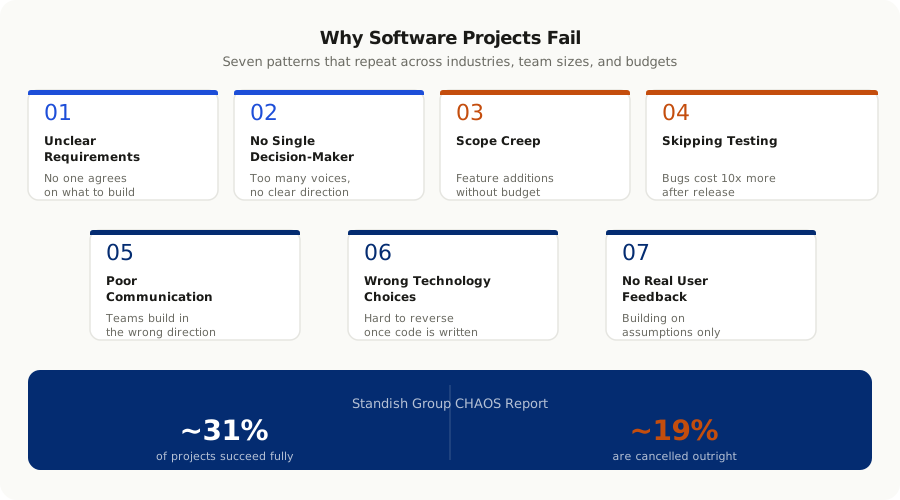
Unclear Requirements From the Start
The single most common cause of software project failure is also the simplest: nobody fully agrees on what is being built.
Requirements that are vague, contradictory, or constantly shifting create a development environment where every decision is a guess. Developers build what they think was asked for. Stakeholders expect something different. The gap between the two grows quietly, until it is too expensive to close.
This does not mean you need a 200-page specification before writing a single line of code. It means that the core problem being solved, the people it serves, and the clear definition of "done" must be agreed before development begins.
A simple test: can every person involved in the project answer the question "what are we building and for whom?" with the same answer? If not, you have a requirements problem, and it will cost you later.
No Single Owner of the Product Vision
Software built by committee rarely ships on time, and rarely ships well.
When decisions need approval from multiple stakeholders with competing priorities, progress slows. Every design choice becomes a negotiation. Every feature request becomes political. The product that emerges tries to please everyone and ends up truly serving nobody.
Successful software projects have one person who owns the product vision. This is not a dictator who ignores everyone else's input. It is a single decision-maker who can say yes or no clearly, resolve conflicting priorities quickly, and keep the team moving forward without waiting weeks for consensus.
In startup teams, this is usually the founder or product lead. In enterprise projects, it might be a product owner or project sponsor. The title does not matter. What matters is that this person exists and has the authority to make calls.
The most expensive phrase in software development is "let us just add one more thing." Every addition to scope without a corresponding adjustment to time or budget is a hidden cost that compounds.
Scope Creep: The Silent Budget Killer
You start with a clear feature list. Then someone suggests a small addition. Then another. Then a third. Each request seems reasonable on its own. Together, they push the project 40% over budget and three months past the original deadline.
Scope creep happens when the boundaries of a project are not actively defended. New ideas are welcome, and adjusting requirements as you learn more is healthy. But every change needs a process behind it: document it, estimate the cost, and decide whether it belongs in the current release or gets deferred.
The discipline of saying "that is a great idea for version two" is what separates software that ships from software that is permanently in progress.
Skipping Testing Until the Very End
Testing is almost always the first thing cut when a project runs over time or budget. This is exactly backwards.
A bug caught during development takes minutes to fix. The same bug found by a real customer after launch takes days: diagnosing what went wrong, building and testing a fix, deploying it, communicating with affected users, and trying to repair any trust that was lost. The cost difference is not small.
A realistic project plan builds testing in from the beginning, not only at the end. Unit tests, integration tests, user acceptance testing, and performance checks are not optional extras. They are how you know whether the thing you built actually works the way it is supposed to.
Teams that skip testing do not save time. They borrow it from their future selves at a very high interest rate.
Poor Communication Across Teams
Software development involves many people: developers, designers, product managers, business stakeholders, and end users. When communication between these groups breaks down, problems multiply.
Developers build in the wrong direction for two weeks before anyone notices. Design decisions get implemented incorrectly because nobody checked. Stakeholders are surprised at the review meeting by things they would have flagged in a short conversation two weeks earlier.
The fix is not more meetings. It is better communication habits: short daily check-ins between the people doing the work, clear documentation of decisions (not just discussions), regular demos to stakeholders so surprises are caught early, and explicit feedback loops with real users.
The teams that consistently ship good software talk to each other constantly. Not in long, formal status updates, but in quick, purposeful exchanges that keep everyone pointed in the same direction.
Choosing Technology for the Wrong Reasons
Technology choices made at the start of a project are very difficult to reverse once development is underway. Picking a framework that does not scale, a database that cannot support the data model, or a third-party dependency with poor reliability creates problems that compound the longer the project runs.
Technology choices should be driven by what the project actually needs, not by what is trending at conferences, what the team finds most interesting to work with, or what was used on the last project regardless of fit.
This is where experienced guidance pays for itself many times over. A technical lead who has built similar systems before will recognize risks that a less experienced team may not see until it is far too late to change course cheaply.
Not Involving Real Users Until Launch
Software built without user feedback is software built on assumptions. And assumptions about what users need, how they think, and how they will interact with your product are almost always at least partially wrong.
The only way to find out where your assumptions are wrong is to put the software in front of real users as early as possible, watch what they do, and use that information to adjust. This is the core idea behind MVP development: build the smallest version that real people can actually interact with, collect honest feedback, and let that feedback drive what you build next.
Discovering that users do not want a particular feature before you build it is far cheaper than discovering it after. And it happens more often than most teams expect.
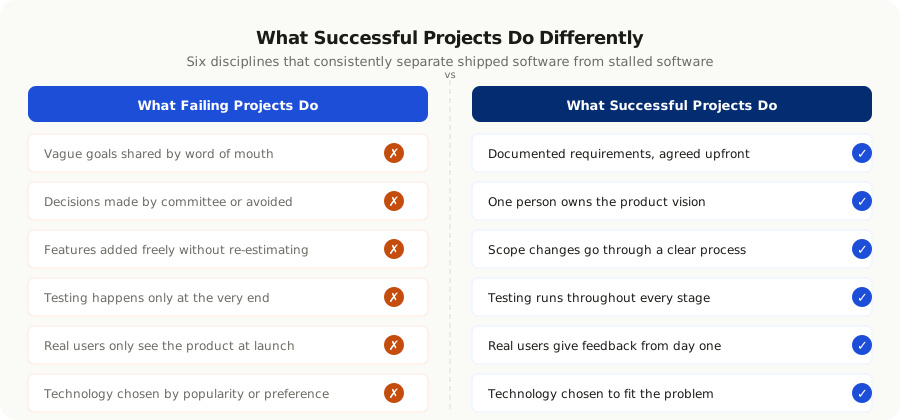
What Successful Projects Do Differently
The teams and companies that consistently deliver software on time and on budget are not luckier or more technically talented. They follow a set of practices consistently, even when those practices feel slow or uncomfortable in the moment.
| Practice | What It Looks Like |
|---|---|
| Clear requirements | A written document everyone has read and agreed to |
| Single decision-maker | One named person who has final authority on product calls |
| Scope control | A formal process for evaluating any change to the plan |
| Continuous testing | Tests written alongside code, not after everything is built |
| User feedback loops | Real users interacting with real builds, regularly |
| Deliberate tech choices | Technology selected for the problem, not the preference |
None of these are complicated ideas. The challenge is maintaining the discipline to follow them under pressure, tight deadlines, and the constant temptation to skip steps in order to move faster in the short term.
Six Questions to Ask Before Your Next Project Starts
Work through these before a single line of code is written:
- Can every stakeholder describe what you are building in one clear sentence?
- Is there one named person with final authority over product decisions?
- Do you have a documented scope with a change process attached to it?
- Is testing planned from day one, not added at the end?
- Do you have a plan for getting real user feedback during the build?
- Have you asked your development partner the hard questions about how they handle delays, scope changes, and problems?
If you cannot answer yes to all six, that is where the preparation work should go. It will pay for itself many times over compared to discovering those gaps six months into a build.
Choosing the Right Development Partner
Many software project failures begin not with bad code, but with a bad selection process. Choosing a development team based on the lowest quote, the flashiest portfolio, or the fastest turnaround is a reliable path to disappointment.
The right partner for your project is one who understands your business goals as clearly as your technical requirements, has an honest and transparent process for handling changes and problems when they arise, communicates proactively rather than waiting to be asked, and has built systems similar to yours before.
Before signing any contract, ask:
- How do you handle it when requirements change during the project?
- Can I speak with a reference from a previous client in a similar situation?
- Who specifically will be working on my project day to day?
- How do you plan and handle testing throughout the build?
- What happens if the project runs over time or budget?
The answers to these questions tell you more about whether a partnership will succeed than any proposal or portfolio ever can.
Software development is not primarily a technical challenge. It is a coordination challenge. The teams that master coordination consistently deliver better outcomes than those that are technically strong but poorly aligned.
One Last Thing
Software is one of the highest-leverage investments a business can make. A well-built product that solves a real problem creates compounding value for years. A poorly executed project drains resources, damages morale, and often sets a company further back than if it had done nothing at all.
The difference between these two outcomes is almost never technical skill. It is process, communication, and the discipline to do the hard preparation before the exciting building begins.
The patterns of failure are well known. So are the habits of teams that succeed. The only question is whether you are willing to follow those habits even when pressure makes it tempting to skip them.