Most businesses that hire the wrong development company do not realize it until months in. By then, they have already paid a deposit, spent weeks writing requirements, and are now watching deadlines slip. The real damage shows up later: software that breaks under load, code no other team wants to touch, and technical choices that cost far more to undo than they ever saved.
This guide gives you a practical framework for making the right call before you sign anything.
Why This Decision Matters More Than You Think
Picking a software development company is not like hiring a contractor to renovate your office. You are choosing a technical partner who will shape how your business operates, competes, and scales for years.
A bad renovation can be fixed with enough money. Bad software architecture can take years and far more money to untangle. The three most common ways a bad hire goes wrong:
- You get a working product that cannot scale or be maintained by anyone else
- You lose weeks to miscommunication and misaligned expectations
- You end up owning code only the original team understands
| What goes wrong | Short-term impact | Long-term impact |
|---|---|---|
| Poor code quality | Bugs at launch | Years of expensive patches |
| No testing process | Hidden issues in production | System failures affecting real users |
| Bad architecture choices | Works for now | Cannot scale without a full rewrite |
| Poor communication | Delays and confusion | Missed business objectives |
| No post-launch support | Scrambling after go-live | Long-term dependency on one vendor |
The Five Types of Development Partners
Not every project needs the same type of partner. Understanding the main options helps you match the right team to your actual situation.
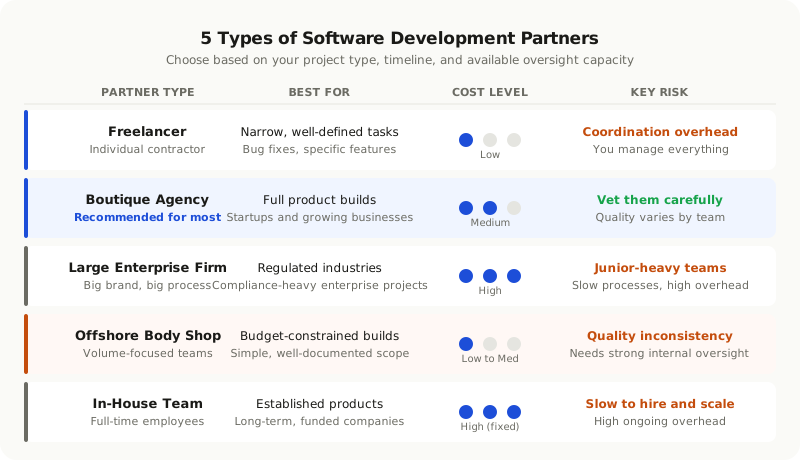
**Freelancers** work individually and usually cost the least upfront. They work well for narrow, well-defined tasks like building a specific feature or fixing a clear technical problem. The risk is coordination. For a full product build, you will be managing multiple independent people with no shared process, which takes real time and real technical expertise to do well.
**Boutique development agencies** are small, focused teams that specialize in specific types of products or industries. They bring a structured process, consistent communication, and usually a more senior team than larger firms provide at the same budget. This is the right choice for most product builds.
**Large enterprise firms** bring size, certifications, and recognized brand names, which matter in compliance-heavy industries. They also bring significant overhead, junior-heavy teams on most actual projects, and pricing that reflects their marketing budget more than the work.
**Offshore body shops** offer the lowest rates in absolute terms. Quality varies enormously. Some offshore teams are excellent. Many are not. Without a strong internal technical lead who can evaluate their work, the risk of low-quality output is high.
**In-house development** is the only option that gives you complete control. It is also the highest fixed cost, takes the longest to build, and carries the most risk if your business needs change. Building in-house makes most sense once you have a validated product and the funding to sustain it long-term.
| Partner type | Best for | Cost level | Main risk |
|---|---|---|---|
| Freelancer | Specific, well-scoped tasks | Low | Coordination burden falls on you |
| Boutique agency | Full product builds, most startups | Medium | Quality varies, so vet carefully |
| Large enterprise firm | Regulated industries, large contracts | High | Junior teams, slow processes |
| Offshore body shop | Budget-constrained simple builds | Low to medium | Quality consistency |
| In-house team | Established products, long-term build | High (fixed) | Slow to staff, high overhead |
Before You Start: Get Clear on What You Actually Need
The clearest sign that a development company is right for you is that they push back on your initial brief. Good teams ask hard questions before they quote. If a company responds to your first message with a proposal and a price, they are guessing.
Before you reach out to anyone, write clear answers to these three questions:
- What is the one problem this product solves?
- Who specifically is it for and how will they use it?
- What does success look like in the first six months after launch?
You do not need a full technical specification. You need enough clarity to have a real conversation. The companies that help you sharpen these answers during a discovery call are worth more than the ones that agree with whatever you say.
Ten Questions to Ask Every Development Company
Ask these in your first meeting. The answers will tell you more than any portfolio ever could.
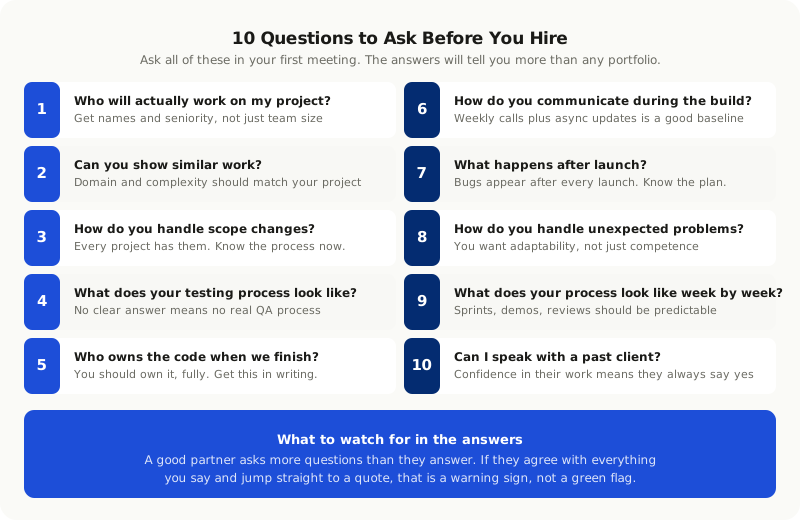
**Who will actually work on my project?** Agencies sometimes pitch senior developers and then staff the project with junior team members. Ask for the names and experience levels of the people assigned to your work, not just the size of the team.
**Can you show me work similar to what I am building?** A strong portfolio of ecommerce sites does not qualify a team to build a healthcare management platform. Ask for work that is close to your domain and your level of complexity.
**How do you handle scope changes?** Every real project has them. A team without a clear process for handling changes will cost you money and cause conflict later. Know the answer before you are in that situation.
**What does your testing process look like?** If they cannot answer clearly, they do not have a real testing process. Software without a QA process is software that breaks in front of your customers.
**Who owns the code when the project ends?** You should own it, completely and without restriction. Get this in writing before the project starts, not after it ends.
**How do you communicate during the build?** Frequency, channel, and format all matter. Weekly calls with async updates in between is a reasonable baseline. Waiting a week for a reply to a straightforward question is not acceptable.
**What happens after launch?** Bugs appear after every launch. Understand what post-launch support exists, at what cost, and for how long. A good team plans for this, not just the delivery date.
**How do you handle problems nobody anticipated?** This is not about finding a team that never hits obstacles. Every team does. It is about finding a team that communicates well and adapts quickly when they do.
**What does your development process look like week by week?** Sprints, milestones, demos, and review points should be predictable and consistent. If the answer is vague, the process probably is too.
**Can I speak with a past client?** A team confident in their work will always say yes. A team that hesitates has something worth being cautious about.
Good development partners ask more questions than they answer in the first conversation. They are more interested in understanding your problem than impressing you with credentials.
Red Flags That Should Make You Stop
Watch for these in early conversations and in written proposals:
- A proposal that skips any discovery process and jumps straight to a price
- Guarantees that the project will take less time than your instincts suggest
- No mention of testing or QA anywhere in the process description
- Reluctance to name who will specifically be working on your project
- Code delivered through proprietary systems that lock you into their platform
- No examples of projects that went sideways and what they did about it
- Communication that is slow or unclear during the sales process (it will be worse during delivery)
A company that says yes to everything and never challenges your assumptions is not a promising sign. Real technical partners push back on things that will not work. That honest feedback is part of what you are paying for.
How to Read a Portfolio Properly
Screenshots tell you almost nothing useful. What matters is the story behind the work.
For each piece of portfolio work you review, ask the team:
- What was the actual problem the client brought to you?
- What did you build and why did you choose that particular approach?
- What did not go according to plan and how did you handle it?
- What did the client outcome look like three to six months after launch?
A team that can answer these questions clearly and specifically understands their own work. A team that shows you polished screenshots but cannot go deeper is selling aesthetics, not results.
Understanding Proposals and Pricing
Two main pricing models exist: fixed-price and time-and-materials.
**Fixed-price** contracts define a scope and set a total cost upfront. They give you budget certainty but require a detailed specification before work begins. Any changes to scope after signing become additional contract negotiations. This model works best when requirements are clear and unlikely to change significantly.
**Time-and-materials** contracts charge for actual work done, by the hour or week. The final cost depends on what gets built. This model is more flexible and usually produces better outcomes for complex products because the team can adapt as the work progresses. The tradeoff is that the final bill is not fully predictable.
For most early-stage products, time-and-materials with a defined budget cap is the most practical approach. It keeps flexibility without removing all financial limits.
When reviewing any proposal, make sure it covers:
- A clear written description of what is in scope
- What is explicitly out of scope
- Milestones with expected delivery dates
- A defined review and approval process at each stage
- Terms around complete code ownership
- Post-launch support terms and pricing
A proposal that is vague on any of these is worth pushing back on before you sign anything.
What a Good Working Relationship Looks Like
Signing the contract is not the finish line. The quality of your collaboration throughout the build directly determines the quality of what gets delivered.
What to expect from a good partner during the project:
- Regular demos of working software, not just written status updates
- Honest flagging of risks and blockers before they become real problems
- Clear escalation paths when decisions need to be made quickly
- Your input welcomed on product decisions, not just rubber-stamp approvals on technical ones
Your role matters too. Being available to answer questions, making decisions promptly, and giving clear feedback at review points directly affects delivery speed. Development work stalls when client decisions stall. Keep that in mind when you are reviewing timelines.
Making the Final Decision
The right development partner will make you feel informed and confident, not just impressed. They will show you how they work rather than simply telling you they are good. They will ask about your business goals before they talk about technology choices.
| Signs you found the right partner | Signs to keep looking |
|---|---|
| They ask more than they tell in the first meeting | They jump straight to a quote |
| They push back on things that will not work | They agree with everything you say |
| They show process, not just portfolio | They show screenshots with no context |
| Communication is fast and clear during sales | Replies are slow or vague before you sign |
| Past clients will speak with you | References are unavailable or generic |
Trust is built through process transparency, consistent communication, and honest conversations about risk. That is what separates the right choice from a costly mistake.
At Angrio, every project starts with a discovery phase where we ask more questions than we answer. The goal is to understand your problem well enough to build the right solution, not to impress you in the first meeting. If you want that kind of partnership, we would like to talk.