When businesses decide to bring in outside help for software development, they often jump straight to "how much does it cost?" and "how fast can we start?"
Those are the wrong first questions.
The more important question is: which engagement model fits what you are actually trying to do? Hiring ten developers through the wrong structure can cost you more time, money, and frustration than hiring two the right way.
This guide breaks down the three most common outsourcing models in plain English, explains when each one makes sense, and gives you a simple framework for making the right choice.
The Three Models, Explained Simply
Most software outsourcing arrangements fall into one of three buckets.
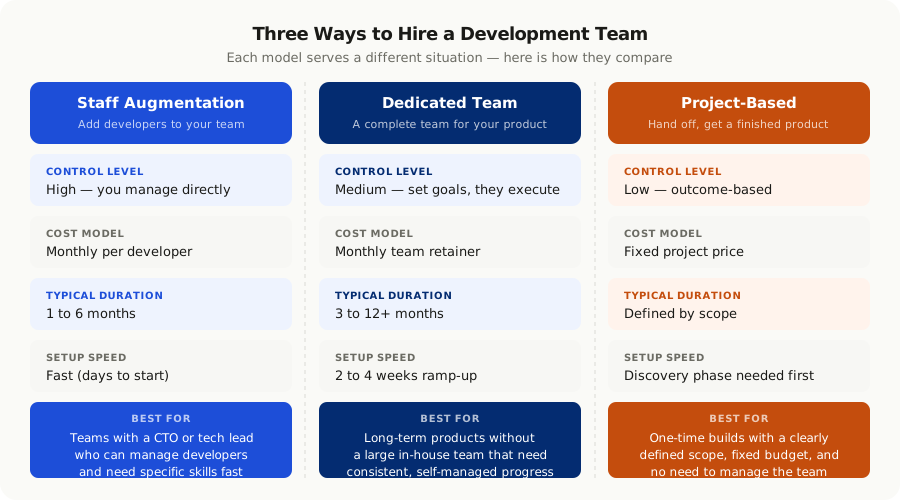
**Staff Augmentation** means you hire individual developers who work alongside your existing team. You manage them day to day. They use your tools, attend your stand-ups, and work on your priorities. The vendor handles employment, payroll, and benefits. You get the talent without the HR overhead.
**Dedicated Development Team** means you hire a complete, self-managed team that works exclusively on your product. The team typically includes developers, a project manager, a QA engineer, and sometimes a designer. They operate like an extension of your company but manage themselves. You set the goals; they figure out how to reach them.
**Project-Based Outsourcing** means you hand a defined scope to an agency and they deliver a finished product. You agree on what gets built, by when, and for how much. Day-to-day execution stays entirely in their hands. You review milestones and accept the final deliverable.
Each model is useful. None of them is universally better than the others. The right fit depends on what you already have in place, what you are building, and how involved you want to be.
When Staff Augmentation Makes Sense
Staff augmentation works best when you have a core technical team and a clear skill gap.
Maybe your backend team is strong but you need three iOS developers for the next six months. Maybe you are hitting a deadline and need extra engineers for a sprint without committing to permanent hires. Maybe you have a new technology and need someone experienced to lead while your team learns alongside them.
**Good fit if:**
- You have a CTO, tech lead, or product manager who can manage developers directly
- You need specific skills your team does not currently have
- Your team already has workflows, tools, and standards in place
- You want to scale up quickly for a defined period
**Not a good fit if:**
- You do not have internal technical management capacity
- You are building a product from scratch with no existing team structure
- You need someone else to plan and prioritize the work
The key variable here is management bandwidth. Augmented developers do not manage themselves. If you cannot actively direct their work, you will not get the output you expect.
When a Dedicated Development Team Makes Sense
A dedicated team is built for longer, sustained product development where you need consistent output but do not want to manage every individual contributor yourself.
Think of it like hiring a small department. The team has its own internal structure, runs its own stand-ups, and delivers results at a product level rather than a task level. You define what success looks like each month or quarter. They work out how to get there.
**Good fit if:**
- You are building a product that will grow over months or years
- You want team continuity (the same people learning your product deeply over time)
- You have a product vision but not a detailed technical specification
- You want to move fast without adding permanent headcount to your payroll
**Not a good fit if:**
- You have a single, short, clearly defined project
- Your budget is fixed and cannot absorb a recurring monthly team cost
- You want direct, daily control over individual tasks
Dedicated teams have a ramp-up period. The first few weeks are spent getting aligned on your product, your codebase, and your processes. Businesses that need something built in six weeks and done are usually better served by project-based outsourcing.
When Project-Based Outsourcing Makes Sense
Project-based outsourcing is the right model when you know exactly what you need and want someone to just handle it.
You write the specification (or work with the agency to write it). They build it. You review and accept the deliverable. It is the most hands-off model and works well for defined, bounded work.
**Good fit if:**
- The scope is clear and unlikely to change significantly during the build
- You want a fixed cost and a firm delivery date
- You do not have time or bandwidth to manage a team day to day
- It is a one-time project rather than ongoing development
**Not a good fit if:**
- Your requirements are likely to evolve during the build
- You need close visibility into the process, not just the outcome
- You are building the core of a long-term product you will continue developing after launch
The biggest risk with project-based outsourcing is scope creep. When requirements change after the contract is signed, it leads to change orders, delays, and budget overruns. The more clearly you can define what you want before starting, the better this model works.
Cost Comparison
Costs vary by region, technology stack, and team size. Here is a general comparison of how these models differ at a structural level:
| Factor | Staff Augmentation | Dedicated Team | Project-Based |
|---|---|---|---|
| Pricing structure | Monthly per developer | Monthly team retainer | Fixed project price |
| Typical minimum term | 1 to 3 months | 3 to 12 months | One-time |
| Cost predictability | Medium (headcount varies) | High (team is fixed) | High (fixed price) |
| Hidden cost risk | Medium | Low | High (scope changes) |
| Startup costs | Low | Medium | Low to medium |
| Best for budget type | Variable budget | Stable recurring budget | Fixed one-time budget |
The cheapest model upfront is rarely the cheapest model when you factor in delays, rework, and scope disputes. Choose the structure that fits the work, not the one with the lowest initial number.
How to Pick: A Simple Decision Framework
Three questions will get most businesses to the right answer.
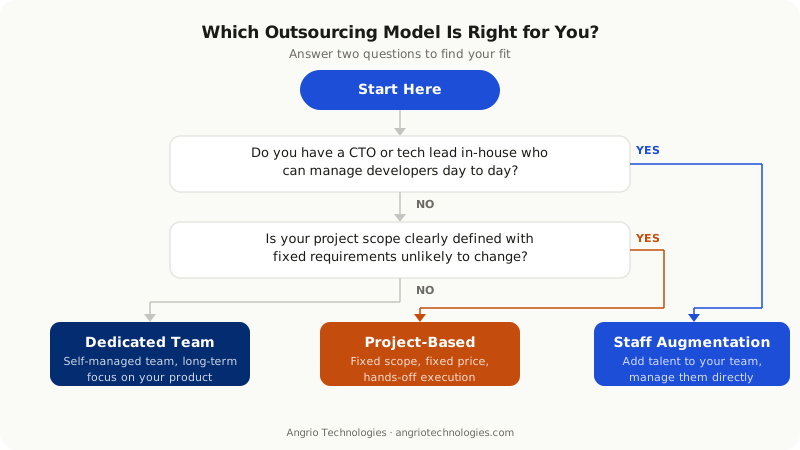
**Question 1: Do you have an in-house technical team that can manage developers directly?**
If yes, staff augmentation is your starting point. You have the management structure already. You just need the talent.
If no, move to question 2.
**Question 2: Is your project long-term or ongoing (more than three to four months of continuous development)?**
If yes, a dedicated team gives you the continuity and self-management you need to make sustained progress without building a full in-house department.
If no, move to question 3.
**Question 3: Is your project scope clearly defined and unlikely to change significantly?**
If yes, project-based outsourcing gives you a fixed price and a firm delivery date.
If no, go back to a dedicated team. An undefined or evolving scope is a recipe for conflict inside a fixed-price engagement.
Five Mistakes to Avoid With Any Model
These mistakes slow businesses down regardless of which outsourcing model they choose.
**Choosing based on price alone.** The model that looks cheapest today often becomes the most expensive once you factor in delays, poor quality, and the cost of fixing what was built wrong. Price is one input, not the whole decision.
**Not defining success upfront.** "Build an app" is not a goal. "Launch an iOS app that lets users book appointments with a three-second maximum load time by the end of Q3" is. The more specific you are, the easier it is to know whether you are getting what you paid for.
**Skipping the communication setup.** Even the best development team will underperform if communication is unclear. Before work starts, decide how often you will meet, through which channels, and who makes final decisions on each side.
**Treating the relationship as purely transactional.** Good outsourcing partners care about your product's success, not just their invoice. When you treat them as order-takers rather than thinking partners, you lose a significant amount of the value they could bring.
**Not planning the transition.** What happens when the engagement ends? Who owns the code? Where does it live? How does your internal team take over? These questions are much easier to answer before work begins than six months in.
The Model Matters Less Than the Match
There is no single best outsourcing model. There is only the best fit for your specific situation.
A startup with a founding CTO who needs three extra React developers will get far more value from staff augmentation than from a fixed-price project engagement. A marketing agency that wants to build a client portal and has no technical staff will be better served by a dedicated team or a clearly scoped project build.
What matters more than the model itself is choosing a partner who is honest with you, transparent about how they work, and focused on making your product succeed rather than simply filling the contract.
Once you know which model fits your situation, finding the right team to work within it becomes a much cleaner process.