A founder I work with hired a prompt engineer last year. Smart hire at the time. The role was clear. Sit with the team, write better prompts, squeeze better answers out of the model, ship features faster. For about six months it worked.
Then it stopped working. The model got smarter. The prompts got shorter. The team kept hitting the same wall. The answers were fine in the prompt playground and wrong in the product. Nobody could explain why a prompt that scored ninety percent on Monday scored fifty on Friday.
So they tried something different. They stopped polishing the prompts. They started shaping the context that the model saw before it ever read the prompt. The system instructions. The data the model could fetch. The memory of past conversations. The tools the model could call. The shape of the request and the shape of the response.
In two months the same product stopped breaking. Customers stopped writing in about strange answers. The prompt engineer was still there, but her title and her job had quietly changed. She is a context engineer now. So is most of the rest of the team.
This shift is happening everywhere I look. By the end of 2026, I think prompt engineering will feel the way frontend coding felt after jQuery. Still useful. Not the main thing. The main thing is context engineering. Here is what that means and how to do it well.
Why Prompt Engineering Was Always a Stopgap
The early prompt era had a simple shape. You opened a chat box, typed a question, and learned to phrase it cleverly. The cleverer you got, the better the answer. A small industry of prompt tips, frameworks, and courses sprang up around that single skill.
It worked because the rest of the system was empty. The model had no memory of you. It could not look up your data. It could not call any tools. The prompt was the only signal it had, so the prompt had to do all the work.
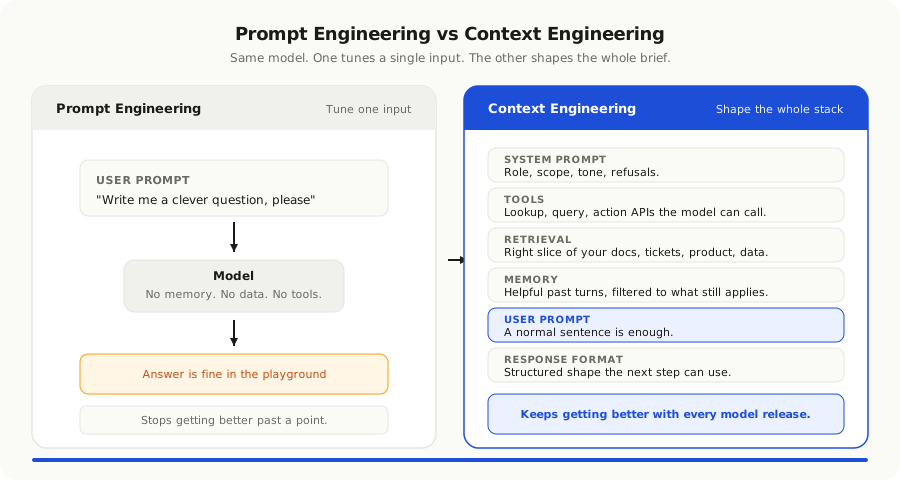
That is not the world anymore. A modern AI feature lives inside a product. The model has a system prompt that runs before the user types anything. It has access to the company's data through retrieval. It has tools it can call. It often has memory across sessions. The user prompt is just the last and smallest input in a long chain.
Trying to get a great answer by tuning only the user prompt is like trying to cook a great meal by seasoning the plate. You can do a little. Most of the work happens earlier, in the kitchen.
Prompt engineering treated the model as a clever stranger you had to convince. Context engineering treats the model as a capable colleague who needs the right brief, the right files, and the right tools to do the job. The difference sounds small. The results are not.
What Context Engineering Actually Is
Strip away the buzzwords and context engineering is the practice of designing everything the model sees, in the right order, at the right level of detail, before it produces an answer.
That sounds abstract, so let me make it concrete. When a user types a question into your AI feature, the model does not see only that question. It sees a stack. Roughly in order, the stack looks like this.
A system prompt that explains who the model is, what it should do, what it should refuse, and how it should sound.
A set of tools the model is allowed to call, each described in a way the model can understand and pick correctly.
A block of retrieved information pulled from your data, your docs, your tickets, your product, or the open web. This is the part most teams know as RAG.
A short memory of past turns in the conversation, or past sessions if your product has long term memory.
The actual user message.
A response format the model is supposed to follow, sometimes a free text answer, sometimes a structured JSON shape your code can use.
Context engineering is the discipline of shaping all of those pieces together. What goes into the system prompt and what does not. Which tools the model can see for this kind of question and which are hidden. What gets retrieved, how much of it gets retrieved, and how it is summarized before it lands in the prompt. How memory is filtered so the model sees what helps and not the rest. How the response format is described so the output is easy for the next step to use.
When all of those pieces are tight, the user can type a clumsy question and still get a precise answer. When any of them is loose, even a perfect prompt cannot save you.
The Four Layers of Context
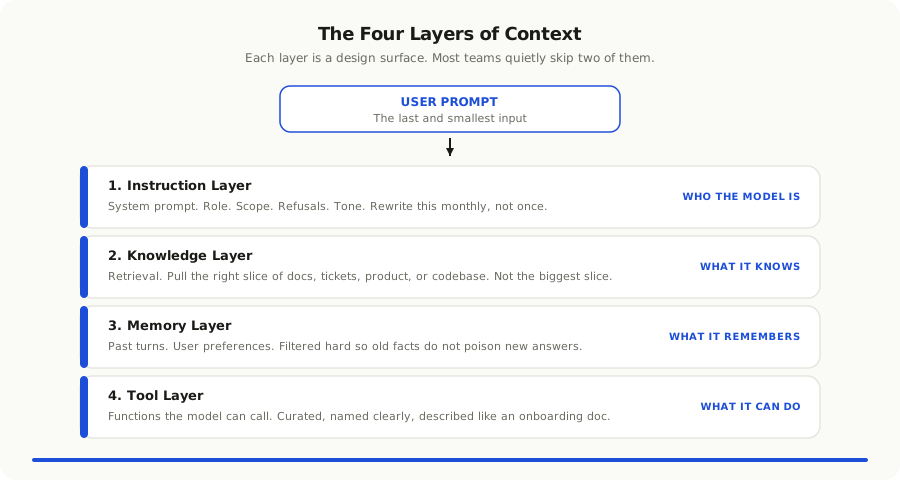
After watching a few dozen teams try this, the same four layers keep showing up. Naming them helps, because most teams quietly skip one or two.
**The instruction layer.** This is the system prompt and the role definition. It tells the model who it is, what its job is, what is out of scope, and how to handle hard cases. Most teams write this once on day one and never touch it again. The teams that get good at AI rewrite it monthly as they learn what users actually ask for.
**The knowledge layer.** This is your retrieval. The product manual, the support history, the policy doc, the codebase, the customer record. The job here is not to throw everything at the model. It is to fetch the right slice for this specific request, summarize it if it is long, and place it in the prompt with clear labels so the model knows what it is looking at.
**The memory layer.** Short term memory is the rest of the current conversation. Long term memory is anything you carry across sessions, like the user's preferences or the last five tasks they did. Memory is powerful and dangerous. Too little and the model feels amnesiac. Too much and it gets confused by old details that no longer apply. The art is in picking what to remember and what to forget.
**The tool layer.** These are the functions the model can call to do real work. Look up an order. Run a query. Send an email. Open a pull request. The names, descriptions, and argument shapes of those tools are part of the context. A poorly named tool will be ignored or called wrong. A clearly described tool gets used correctly almost every time.
A team that treats only one of these as their job will plateau quickly. A team that treats all four as design surfaces will keep getting better long after the model itself stops improving.
Why This Suddenly Works in 2026
Context engineering is not a new idea. The serious AI teams have been doing it for years under different names. What changed is that the tools and the models finally caught up, and the cost of doing it well dropped.
The first shift is the size of the context window. A few years ago, the model could see a few thousand tokens at a time. Today the strong models comfortably handle hundreds of thousands of tokens, and the very strong ones handle a million. That means the team can stuff a small product manual, a recent ticket history, a few tool definitions, and a structured task into a single call without hand wrestling every byte.
The second shift is retrieval and tooling getting standardized. Frameworks for retrieval are mature. Tool calling is a first class feature in every serious model. Protocols like MCP let the same tools plug into many different agents without rewriting the glue. The plumbing is no longer the hard part.
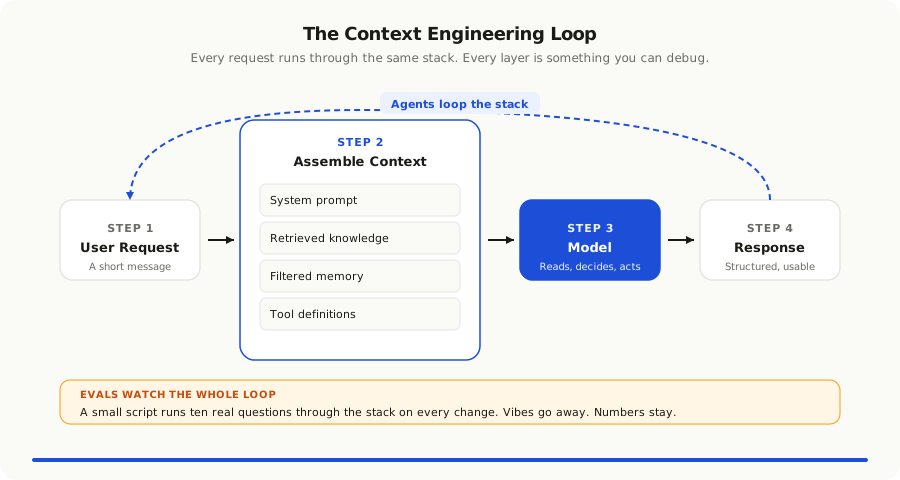
The third shift is the rise of agents. An agent is a loop, not a single call. The model thinks, calls a tool, reads the result, thinks again, calls another tool, and so on. Every step is a new context. If your context engineering is sloppy, an agent will compound the mess across ten turns and produce something nobody can debug. If your context engineering is tight, an agent gets reliable enough to put in front of customers.
Prompt engineering optimized one input. Context engineering optimizes the conditions under which the model has to think.
The teams that figured this out early are now shipping AI features that work on the first try, that fail in predictable ways, and that improve every time they swap in a better model. The teams still tuning prompts in isolation are stuck wondering why their demo never quite makes it to production.
What Changes for the Team
The shift to context engineering does not require a reorg, but it does change how the work feels.
**Roles blur in a useful way.** Backend engineers start caring about prompt structure because they own the retrieval pipeline. Product managers start caring about response formats because they decide how the output flows into the rest of the product. Designers start caring about system prompts because the model's tone is part of the user experience. The job stops belonging to one person and starts belonging to the team.
**Evals replace vibes.** Once the context has many moving parts, eyeballing answers is no longer enough. Teams build small evaluation suites. A set of real questions, a set of expected behaviors, a script that runs the whole stack and scores it. Every change to the system prompt, the retrieval, the tools, or the memory gets tested against the suite before it ships. The team stops arguing about whether the bot got better and starts looking at the numbers.
**Prompts get shorter.** This sounds odd, but it is consistent. When the rest of the context is doing its job, the user facing prompts shrink. The instruction is in the system layer. The data is in the retrieval layer. The user can type a normal sentence and get a great answer. Long, magical incantations are a sign that the context elsewhere is too thin.
**Debugging changes shape.** When something breaks, the question stops being "what prompt should I try" and becomes "which layer failed." Did retrieval pull the wrong document. Did memory carry over a stale fact. Did the tool description mislead the model. Did the response format trip up the parser. Each of those has a different fix, and naming the layers makes the bug obvious.
**The roadmap shifts.** Teams stop planning AI features as one off prompts and start planning them as small additions to a shared context layer. New tools. New retrieval sources. New memory rules. The platform under the features starts compounding, the same way a clean codebase compounds.
**Tool quality matters more than model choice.** The biggest unlock in any given quarter is often a better tool, a smarter retrieval, or a tighter system prompt, not a new model. Teams that obsess over which model is on top this week tend to underinvest in the layers they actually control.
Where Teams Get This Wrong
Context engineering is easy to describe and surprisingly easy to mess up. The same handful of mistakes keep showing up.
**Stuffing everything into the prompt.** A long context window is not a license to dump your whole knowledge base into every call. The model gets distracted, the bill goes up, and latency suffers. The skill is in fetching the right slice, not the biggest slice.
**Treating retrieval as a one time setup.** Retrieval quality is the single biggest lever in most AI products. Teams that set it up once and never measure it ship worse and worse answers as their data grows. A small weekly review of retrieved chunks against a list of real queries pays for itself many times over.
**Hiding tools the model could use.** Some teams expose every internal API as a tool. Others expose almost nothing. Both extremes hurt. The right move is curation. Pick the tools that actually help, name them clearly, describe them like you are onboarding a junior engineer, and prune the rest.
**Forgetting about response format.** A free text answer is fine for a chatbot. It is a nightmare when the next step is code. Teams that define a clean schema for the response, and tell the model exactly what shape to produce, save themselves weeks of downstream parsing pain.
**Ignoring evals until something breaks.** A bug in production is the worst time to start writing tests. Build a small eval set on day one, even if it has only ten questions. Run it before every change. Grow it whenever you find a real failure. This single habit separates teams that get steadily better from teams that get steadily worse.
**Confusing context engineering with model fine tuning.** Fine tuning has its place, but it is rarely the first move. Most quality problems can be fixed by changing the context, not the weights. Reach for a better system prompt or a better retrieval before you reach for a custom model.
**Letting context engineering live in one head.** If only one person on the team understands how the layers fit together, that person becomes a bottleneck and the system becomes fragile. Write down the shape of the context. Review it as a team. Treat it like architecture, because that is what it is.
A Pragmatic Way to Start
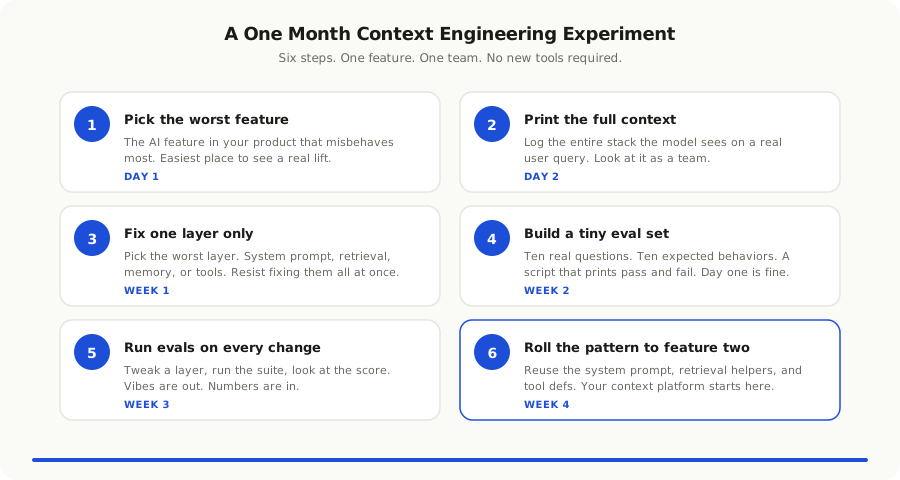
You do not need a new platform to begin. You need one feature, one afternoon, and a willingness to look at all four layers.
Pick the AI feature in your product that misbehaves the most. Open the code that builds the prompt. Print the full context the model sees on a real user query. Most teams are surprised at what they find. Half empty system prompts. Retrieval that returns three pages when one paragraph would do. Tools described in a sentence the model cannot understand. Memory carrying over things from yesterday that no longer apply.
Pick the layer that looks worst. Fix only that one. Rerun the same query and a few others. Note what changed. If you do not have an eval set, build a tiny one this week. Ten real questions, ten expected behaviors, a script that runs them in a loop and prints the result. That is enough to start.
Once you have done that for one feature, do it for the next. After three or four features, you will have a small library of shared system prompts, shared retrieval helpers, shared tool definitions, and a habit of running evals on every change. That library is your context platform. It will compound from there.
If you are already working in a [spec driven](/blog/spec-driven-development-replacing-tickets-2026) way, the spec is the natural home for context decisions. The spec for an AI feature should name which retrieval sources it uses, which tools it can call, what the response format is, and what the eval looks like. The same document that drives the engineering work also drives the context design.
The Bigger Pattern
Step back and the trend is bigger than prompts versus contexts. The job of building AI products is shifting from talking to a model to designing the world the model lives in. The system prompt is your culture document. Retrieval is your library. Memory is your team's institutional knowledge. Tools are the things the model can actually do. The user prompt is just the last sentence in a much longer conversation that you wrote on the model's behalf.
That framing is more honest. It also matches what we already know about humans. A great hire fails in a chaotic environment with no context, no docs, and no tools. A modest hire shines in a clear environment with strong docs and clean tools. Models are the same. The model you have today is good enough for most of what your product needs. The question is whether your context is good enough to let it show.
This is the same pattern we have seen before. When databases got fast, the bottleneck moved to schema design. When the cloud got cheap, the bottleneck moved to architecture. When models got smart, the bottleneck moved to context. The teams that notice the shift early get a head start that is hard to catch up to later.
If you want one thing to take from this post, take this. Stop tuning prompts in isolation. Look at the whole stack. Name the four layers. Pick the worst one. Fix it. Measure. Repeat. The teams that build that habit will spend the next year shipping AI features that feel like magic, while everyone else keeps wondering why their prompts stopped working.
The prompt did not stop working. The world around it just got bigger, and the work moved.