A founder messages you on a Sunday night. They have spent the weekend in Cursor, or Lovable, or Claude Code, and they have a working app. Login screen. Dashboard. Data. It looks polished. They want to launch it on Monday.
This is the new face of software in 2026, and it has a name. People call it vibe coding. The term was coined in 2025 and it spread fast because it captures something real. You no longer write code line by line. You describe what you want, the AI builds it, you check the vibe, you ask for changes. Repeat until it feels right.
The promise is huge. The risks are real. This post explains what vibe coding actually is, where it shines, where it quietly breaks, and how to use it without ending up with a product that becomes a nightmare to maintain six months from now.
What Vibe Coding Actually Means
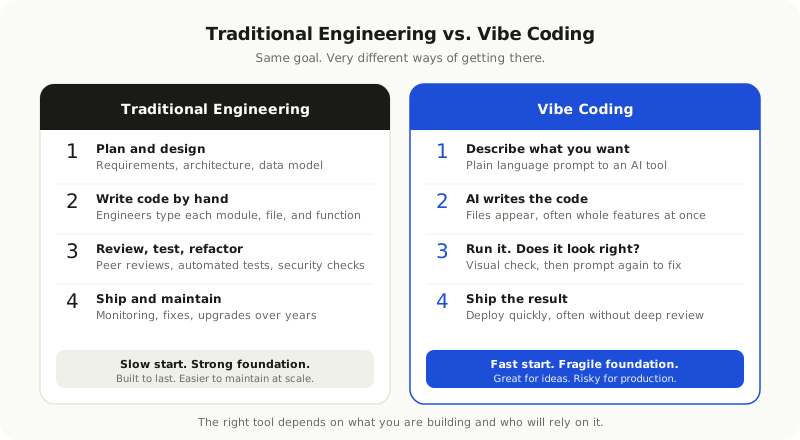
Vibe coding is building software mostly through conversation with an AI tool. You write a prompt in plain English. The AI writes the code, opens files, and runs the app. You look at the result. You either say "yes that is good" or "make this part different." You repeat until it works.
The key word is "mostly." Some people read every line the AI produces. Some people read none of it. The pure form of vibe coding is when you do not read the code at all. You only judge the output.
The tools driving this shift are familiar names by now. Cursor and Claude Code for engineers who still want to see the code. Lovable, v0, and Replit Agent for founders who want a working app from a prompt. Bolt and a dozen other browser based builders for landing pages and simple SaaS products.
All of them share the same core idea. Move the human from author to director. Let the AI do the typing.
Why Vibe Coding Spread So Fast
Three forces made vibe coding possible at the same time.
AI models got good enough to produce working code on the first try, most of the time, for common tasks. The tooling around those models matured. Editors learned to read your codebase, run commands, and check their own output. And the cost of an experiment dropped to almost zero. A prototype that used to need a developer for two weeks can now be tried in an afternoon.
For founders, this is a real unlock. Ideas that would have died in a backlog can be tested in a day. For engineers, it removes a lot of the boring parts of the job. Setting up a project, wiring up forms, writing the tenth CRUD endpoint of the year. The AI does it. You move on to the harder parts.
The result is a wave of software being built by people who could not build software a year ago. That is genuinely good. It is also where the mess starts.
Where Vibe Coding Genuinely Works
Some kinds of software are a great match for vibe coding. The pattern is the same in all of them. The cost of getting it wrong is low, and the value of getting it fast is high.
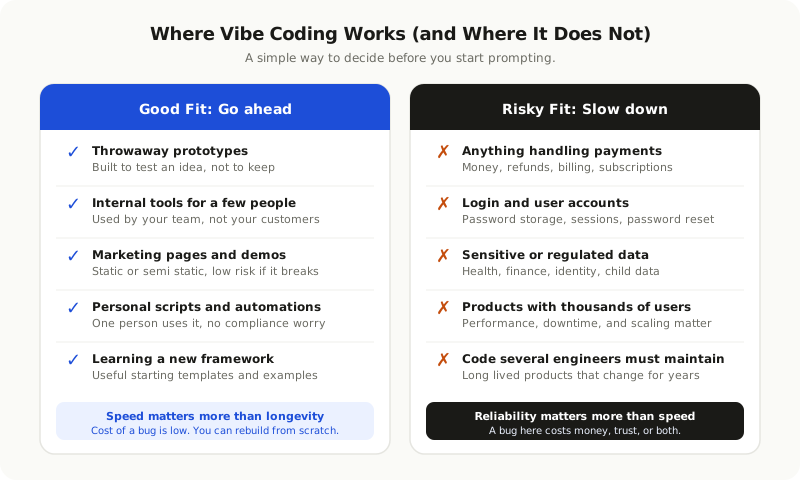
**Throwaway prototypes.** You want to test whether an idea is worth pursuing. The prototype will be deleted after the test. Vibe coding is perfect here. Build it, learn from it, throw it away.
**Internal tools used by a handful of people.** A small dashboard for your operations team. A form that updates a spreadsheet. A weekly report. The user count is low, the data is yours, and if it breaks for a day, life goes on.
**Marketing pages and demos.** Landing pages, microsites, sales decks turned into clickable apps. Content driven, not data driven. The risk of a bug is small.
**Personal scripts and automations.** A script that renames a folder of files. A bot that posts your blog to social media. A small tool that helps you, not your customers.
**Learning a new framework.** When you want to see how something works, asking an AI to build a sample app is one of the fastest ways to learn the patterns. The goal is understanding, not shipping.
In all of these cases, vibe coding gives you speed without serious downside. Use it. Enjoy it.
The simplest test is this. If the code stopped working tomorrow, would anyone besides you be hurt? If the answer is no, vibe code freely.
Where Vibe Coding Quietly Breaks
The trouble starts when the same workflow gets used for things it was never meant for. Five problem areas come up again and again.
Software That Handles Money
Payments, refunds, subscriptions, invoicing. The AI will produce code that looks correct and even runs. The bugs are not in the obvious places. They are in the rounding, in the currency handling, in the corner cases that only show up when a real customer disputes a charge two weeks later.
A wrong line of code in a payment flow does not crash. It quietly charges the wrong amount, and you find out from an angry email.
Login, Accounts, and Anything Security Sensitive
The AI knows the patterns for authentication, but it does not always pick the right one for your situation. Password reset flows with predictable tokens. Sessions that never expire. Permissions that look correct but let any logged in user read another user's data with a small URL change.
These are the kinds of bugs that do not show up in testing because the app appears to work. They show up when someone with bad intent goes looking for them.
Anything Touching Sensitive Data
Health information, financial records, identity details, anything covered by regulations like GDPR, HIPAA, or PCI. The risk is not just bugs. It is the structure of the system. Where data is stored. How it is encrypted. Who can access it. What happens when a user asks to delete their data.
Vibe coding tools are not aware of your compliance obligations. They will produce something that works, and that works is not the same as something that is legal to operate.
Products With Real User Volume
A vibe coded app at ten users is fine. The same app at ten thousand users is often slow, or expensive, or both. Database queries that load every record at once. API calls that fire one at a time when they should be batched. No caching. No background jobs. No way to scale a single piece of the system without rebuilding it.
You only find these problems after launch, after you have grown, when your bill suddenly triples and your customers start complaining about speed.
Code That a Team Has to Maintain
This is the most painful one. A solo founder vibe codes a product. They get traction. They hire engineers. The engineers open the code. They find a few hundred files with no consistent style, no tests, business logic mixed with database calls, and decisions that nobody can explain because nobody made them.
The team now has two choices. Spend months refactoring before they can add anything new, or rewrite from scratch. Either way, the original speed advantage is gone, with interest.
The Hidden Costs People Do Not See Yet
Beyond the obvious bug risks, vibe coding creates four costs that show up later.
**Inconsistent code style.** Each new prompt can produce code that looks different from what was already there. After a few months, the codebase reads like it was written by ten different people, because in a sense it was.
**Untracked technical debt.** When you write code yourself, you remember the shortcuts you took. When the AI writes it, the shortcuts are invisible until they break.
**Knowledge gaps in the team.** If no human really understands how a part of the system works, no human can fix it quickly when it goes wrong. You become dependent on the AI to maintain the AI's earlier work.
**Slower long term changes.** Adding a new feature to clean code takes a day. Adding the same feature to a tangled vibe coded codebase takes a week, because every change risks breaking something nearby.
None of these are fatal on day one. All of them compound. The teams who feel this most are the ones who shipped fast, grew, and then realized that growing further means fixing the foundation first.
How to Vibe Code Without Building a Mess
Vibe coding is a tool. Like any tool, it can be used well or badly. Here is how the better teams are using it.
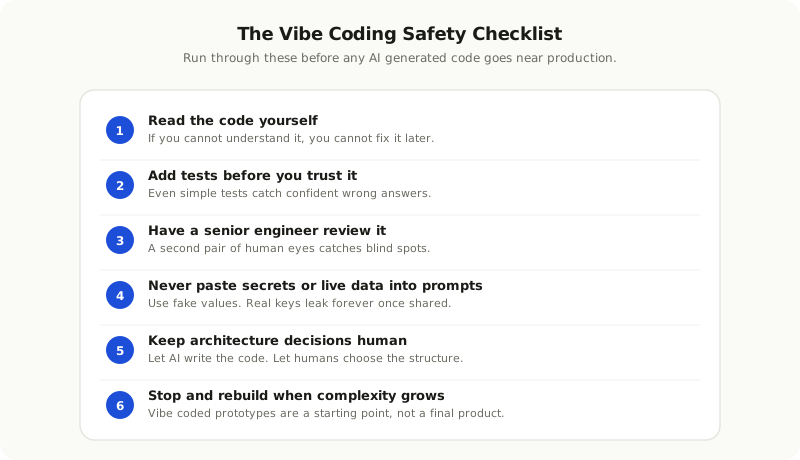
**Read the code yourself before you commit it.** Even if you do not write it, you should understand it. If you cannot, that is a signal that the code is too clever or that you need help.
**Add tests before you trust the code.** A small test suite catches the cases where the AI is confidently wrong. This sounds slow but it pays back the first time it stops a bug from going live.
**Have a real engineer review anything that touches users or money.** Not a long review, just a fresh pair of eyes. They will see things you missed because you are too close to the prompt history.
**Never paste secrets, real customer data, or production credentials into a prompt.** Use fake values. Real keys and real records can leak in ways that are hard to clean up.
**Keep architecture decisions human.** Let the AI write the code. Let a human decide the structure of the project, the data model, and how the parts fit together. The AI is good at the small picture and weaker at the big one.
**Stop and rebuild when complexity grows.** A vibe coded prototype is a starting point, not a final product. When the project starts to matter, plan a real rebuild with engineers who understand what it needs to become.
When to Move From Vibe Coding to Real Engineering
There is a clear moment when the cost of vibe coding starts to outweigh the benefit. If any of these are true, it is time to bring in engineers and rebuild the parts that matter.
You have paying customers and a real business depending on the software. Downtime now costs money. Bugs damage trust.
Your codebase has grown past what one person can hold in their head. You find yourself afraid to change things because you do not know what will break.
You are storing data you cannot afford to lose or leak. Customer records, payment information, anything regulated.
You are preparing for an investment round, an acquisition, or a serious enterprise deal. The other side will ask about your code, your security, and your processes. Vibe coded answers do not survive due diligence.
You are hiring a team. New engineers will need a codebase they can actually work in. Onboarding into a tangle is slow and demoralising.
The good news is that you do not have to throw away the work. The user research, the design choices, the early customers, the proof that the idea works. All of that carries forward. What you replace is the foundation, with eyes open this time.
A Sensible Way to Think About All of This
Vibe coding is not a fad. The tools will keep getting better and more people will keep using them. Treating it like a threat to professional engineering misses the point. Treating it like a replacement for professional engineering also misses the point.
The right way to think about vibe coding is as a new kind of clay. It is fast, soft, and forgiving. You can shape an idea into something tangible in hours. That is genuinely valuable, especially for the early stages of building anything.
But clay is not concrete. When you are ready to build something that holds weight, that lasts, that other people will rely on, you need different materials and different skills. The teams that get this right use vibe coding to find what to build, and proper engineering to build the thing properly.
If you are at that crossover point, the kindest thing you can do for your future self is to stop, plan the rebuild, and bring in people who have done it before. The weekend prototype was the easy part. The next year is where the real work happens, and where the real value lives.