A founder I spoke with last week told me a story that is quietly playing out in a thousand boardrooms right now. Her company sells a popular analytics tool. Three of her largest customers asked the same question on three separate calls. They did not want a new feature. They did not want a price cut. They wanted to know if her team could just send them the answer every Monday morning, instead of asking their staff to log in and build the report.
She thought it was a one off. Then a fourth customer asked. Then a fifth. The pattern was clear. Her customers were not in love with her dashboard. They were tolerating it because it was the only way to get the result they actually wanted.
This is the shift that is reshaping software in 2026. People are calling it service as software. It is not a new framework or a new sales motion. It is a quiet realisation that the thing customers paid for all along was the outcome, and the dashboard was just the bill they had to read to get it. With AI now able to do the work between the data and the decision, that bill no longer needs to be paid.
Here is what is changing, why it is happening now, and how to get in front of it instead of being run over by it.
What Service-as-Software Actually Means
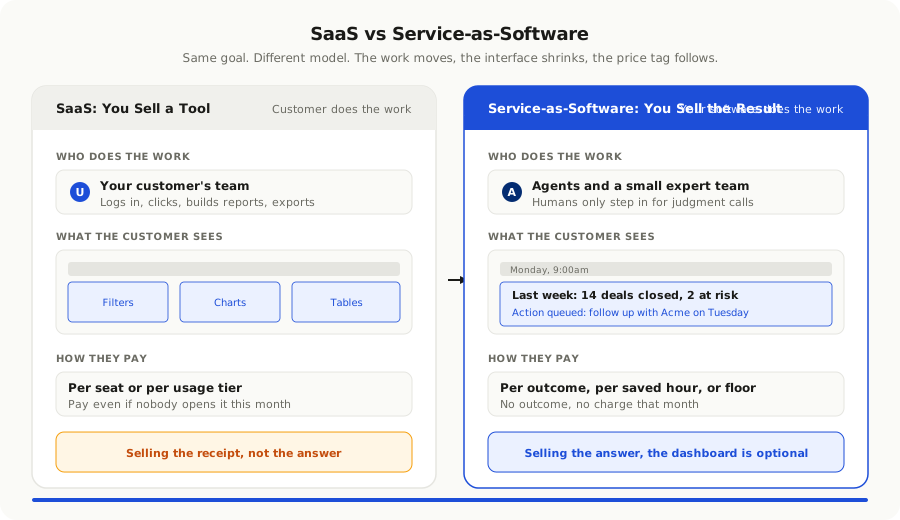
Software as a service, the model that built the last twenty years of business software, gave a customer access to a tool. The customer logged in, did the work, and produced an outcome. The vendor charged for the seat or the usage. The product was the platform. The labour was the customer's problem.
Service as software flips that order. The vendor delivers the outcome. The customer receives a result, a decision, a finished task, or an answer. The software still exists, but it sits behind the scenes. The customer does not have to learn it, train staff on it, or open it every Monday. The product is the result. The labour is now the vendor's problem, and AI does most of it.
The two models look similar from a distance. In a meeting room they sound almost identical. The difference shows up in three places that matter.
The first is who does the work. In SaaS, your customer's team logs in and operates the tool. In service as software, your software operates itself, with a human in the loop only when judgment is needed.
The second is what the customer sees. In SaaS, the customer sees a screen full of options, filters, and reports they have to interpret. In service as software, the customer sees the answer, the recommendation, or the action that has already been taken on their behalf.
The third is how the customer pays. In SaaS, the customer pays per seat or per usage tier, regardless of whether they got value out of it. In service as software, the customer pays for the outcome itself. A resolved ticket. A qualified lead. A shipped invoice. A signed contract.
Why This Is Happening Now
Service as software is not a new idea. Managed services have existed forever. Outsourced agencies have always sold outcomes. What is new is that the cost of producing an outcome reliably has just collapsed, and three forces are converging to make this the default expectation rather than a premium option.
The first force is that AI agents are finally good enough to do the routine work that used to require a person sitting at a screen. Pulling data, summarising it, deciding what to do, writing a draft, sending a follow up. Five years ago, every one of those steps needed a human. Today, a well designed agent can do most of them, and a person only steps in for the calls that matter.
The second force is budget pressure. Every CFO in 2026 is staring at a software bill that grew faster than their headcount. They are tired of paying per seat for tools their team barely uses. They are also tired of the staff time those tools eat. When a vendor offers to deliver the outcome directly, with a price tied to results, it lands as a relief, not as a sales pitch.
The third force is dashboard fatigue. The average mid sized company runs on more than thirty different tools, each with its own login, its own report, and its own little island of insight. Nobody has time to be the integration layer between all of them. The team that promises to deliver the answer instead of one more screen wins by default.
The dashboard was always the receipt. Customers were buying the answer.
Put these three together and you get a quiet revolution in how software is sold. The pitch is not a tour of features. It is a sentence. We will deliver this outcome, on this schedule, for this price.
What Actually Changes Inside the Product
This shift sounds like a marketing change. It is not. Underneath the surface, almost everything about how the product is built has to move.
**The interface shrinks.** The big complicated screen that used to be the main draw becomes a small dashboard for exceptions. Most customers never open it. The new main interface is the email summary, the chat reply, the Slack message, or the report that appears in their inbox without anyone asking.
**The data layer expands.** Delivering an outcome means you cannot ask the customer to clean their own data anymore. Your system has to handle the messiness, the missing fields, and the integrations with their other tools. This is hard work. It is also where the moat is.
**The model layer becomes the product.** The reasoning that used to live in your customer's head, what to do with this number, which lead to call, which invoice to chase, has to live in your software now. That reasoning is built out of prompts, evals, agents, and feedback loops. It is closer to a colleague than a feature.
**The human in the loop becomes a role.** Most service as software products keep a small team of humans who handle edge cases, review high stakes calls, and improve the system over time. This is not a bug. It is a feature. Customers find it reassuring. The job is real, just smaller and more focused than the team they used to need.
**Trust becomes the core feature.** When a customer offloads work to your system, they are trusting you with judgment, not just storage. Logging, audit trails, explainability, and a way to escalate become as important as the underlying model. The product is not done when the answer is right. It is done when the customer can see why the answer is right.
The teams that get this transition correct stop thinking about themselves as software companies and start thinking about themselves as outcome companies that happen to use software.
The Pricing Model Has to Move Too
A service as software product priced per seat will quietly fail. The customer is no longer hiring seats. They are hiring results. The price has to follow.
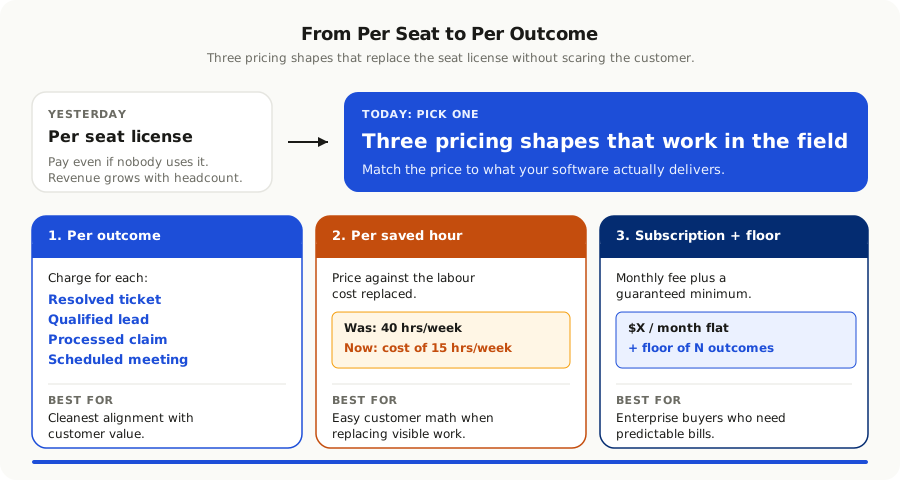
Three pricing shapes are working in the field right now.
**Per outcome.** Pay for each resolved ticket, qualified lead, processed claim, or scheduled meeting. This is the cleanest version. It aligns the vendor with the customer's actual goal. It also takes nerve to roll out, because revenue becomes lumpier and easier to forecast wrong in the first quarter.
**Per saved hour.** Price the tool against the labour cost it replaces. Customer used to spend forty hours a week on this. We deliver the same result for the cost of fifteen hours. The math is easy for the customer. The risk is that the customer questions the saved hour count later if the work is not visible.
**Subscription with an outcome floor.** A monthly platform fee plus a guarantee of a minimum number of outcomes per month. The customer gets a predictable bill. The vendor gets a predictable revenue line. Both sides win on simplicity, and most enterprises sign these faster than the pure per outcome version.
The wrong move is to keep the SaaS price tag and try to sell the outcome on top. Customers see through it. They have stopped paying twice for the same thing.
Where Teams Get This Wrong
Almost every team trying this transition stumbles in the same few places. None of them are surprises if you know what to look for.
**They keep building the dashboard.** Engineering keeps shipping new screens, new filters, new widgets. The team is still scoring points for tool features instead of outcome quality. If your roadmap is mostly a list of UI improvements, you are still building SaaS in disguise.
**They underestimate the data work.** A demo that works on clean test data falls apart on real customer data. Service as software lives or dies on the quality of the integration and cleanup layer. This is the unglamorous, expensive part that most plans skip. Without it, the outcome you promised arrives wrong, late, or not at all.
**They skip evals.** When the product is the reasoning, you need a way to measure whether the reasoning is right. Most teams only catch failures when a customer complains. The good teams have a constant scoreboard that grades every outcome against a known answer. Without that, your quality silently drifts and your customers leave silently with it.
**They hide the human team.** Most service as software products have humans in the loop, and most teams are embarrassed about it. They should not be. Customers do not care if a person reviewed the answer. They care that the answer was right. Show the human review as a feature, not a secret.
**They mix the two models in one product.** A product that is half SaaS and half service as software confuses everyone. Sales does not know what to pitch. Engineering does not know what to ship. Customers do not know what they bought. Pick a side for each product, and if you need to do both, build them as separate offerings.
**They wait for permission.** Many teams wait for their biggest customer to ask for service as software. That customer will never ask. They will quietly switch to a competitor that already offers it. The first vendor in any category to make this shift sets the new normal for the rest.
A Practical Way to Start
You do not need to rebuild your product to start. You need to pick one outcome, one customer segment, and one quarter to prove the model.
**Step one: pick one job your customer hates doing.** Not your most popular feature. The one your customer complains about, postpones, or does badly because they do not have time. The boring repetitive job your tool barely helps with today. That is your candidate.
**Step two: define the outcome in one sentence.** "We will deliver X, by this time, with this quality." If you cannot say it in a sentence, you have not picked an outcome. You have picked a feature.
**Step three: do it manually for ten customers.** Before any code, your team delivers the outcome by hand. You will learn more in two weeks of doing the work than in three months of designing software for it. You will also learn the real edge cases that no spec would have caught.
**Step four: automate the boring parts.** Now build the agents, the integrations, and the evals for the steps that you found were repetitive and safe to automate. Keep humans on the steps that need judgment. The goal is not to remove humans completely. The goal is to make each human ten times more effective.
**Step five: change the price tag.** Move the pricing for this offering to per outcome, per saved hour, or subscription with an outcome floor. Treat it as a separate product line at first, even if it lives next to your SaaS. Measure gross margin and customer love separately.
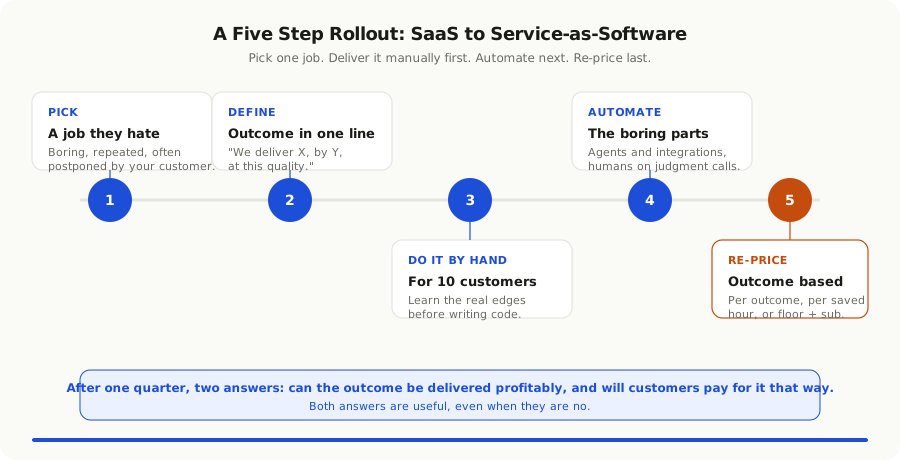
After one quarter, you will know two things. Whether the outcome can be delivered profitably with your current technology, and whether customers will pay for it the way you priced it. Both answers are useful, even when they are no.
What This Means for Custom Software in 2026
If you are a buyer rather than a builder, this shift changes how you should evaluate every new software purchase. The old questions were about features, integrations, and seat licenses. The new questions are different.
What outcome will this vendor deliver, and what is the price per outcome. Who is on the hook when the outcome is wrong. How is the quality measured, and can I see the scoreboard. What happens to my data after the outcome is delivered. How quickly can I switch if the outcome stops being good.
A vendor that cannot answer those questions clearly is selling you a tool, not a service. There is still a place for tools. Just be honest with yourself about which you are buying, and price the labour your team will spend on it into the comparison.
For builders, the takeaway is simpler. The customer's question has changed. They used to ask "does your product do this." They are starting to ask "can you just do this for me." The companies that hear that question and answer yes will own the next decade of business software. The ones that keep selling logins will spend that decade explaining why their seat count keeps shrinking.
If you are wondering how this fits with [designing software for AI agents as the second user](/blog/designing-software-for-ai-agents-the-second-user-2026), the connection is direct. Service as software is what happens when the agent becomes the primary operator of your software, and the human becomes the primary consumer of the result. The agent first product is the building block. The service first business model is what you sell on top of it.
The Bigger Picture
Step back and the trend lines all point the same way. Customers want results. Budgets are getting tighter. AI is making outcomes cheaper to produce reliably. Dashboards are becoming the long tail, not the main event.
This is not the end of SaaS. Tools are still useful. Some jobs genuinely need a human at a screen, and a great interface for that human is worth a lot of money. But the centre of gravity of the software industry is moving from "we make a tool" to "we deliver a result." The companies that move with it will look very different in five years. They will be smaller in employee count. Larger in revenue per customer. Closer to their customers' real work. And quietly less software like, in the way the average person thinks about software.
The good news is that you do not need to bet the whole company on this shift. Pick one outcome. Deliver it for one customer segment. Price it for the result. Watch what happens. The first time a customer tells you they no longer want to log in, you will know exactly what to do next.
The dashboard had a great run. It is okay to let it become a back office tool and put the outcome on the front page instead.