A CTO I work with found out last quarter that his sales team had been writing every client proposal with ChatGPT for nine months. He did not learn this from a tool or an audit. He learned it because one client noticed that two competing vendors had sent proposals with the same three odd phrases in them. Both vendors had used the same model, the same prompt template, and the same free account. One of them was his team.
He was not angry. He was confused. His company had a clear policy that said no employee may paste customer data into a third party AI tool. The sales team knew the policy. They had all signed it during onboarding. They had also, every single one of them, ignored it. Not out of rebellion. Out of speed. The proposals that used to take six hours now took twenty minutes. Nobody wanted to go back.
This is shadow AI. It is the part of your company's AI usage that you cannot see, did not approve, and only learn about by accident. By the middle of 2026, almost every business has it. Most leaders still think they do not. This post is about what shadow AI really is, why it spreads inside even strict companies, the risks that show up later, and what to do about it in a way your team will actually follow.
What Shadow AI Really Means
Shadow IT is an old idea. It is the marketing team that bought a Dropbox account on a personal credit card because the official file share was too slow. It is the support agent who used a personal Trello board to track tickets because the official tool kept timing out. For thirty years, every IT team has had to deal with the gap between what the company allows and what the worker actually needs to get the job done.
Shadow AI is the same idea with a sharper edge. An employee opens ChatGPT on a personal account, pastes a piece of work into the chat, and lets the model do the heavy lifting. The result is a faster employee, a happier customer, and a quiet trail of company data living in a chat window that the company has no record of. Multiply that by a hundred people, and the trail turns into a flood.
The reason shadow AI spreads faster than shadow IT ever did is that the entry cost is zero. There is no credit card. There is no sign up form that asks for a company email. The employee opens a browser tab, types a question, and gets an answer that feels like a teammate's reply. The friction is gone. So is the visibility.
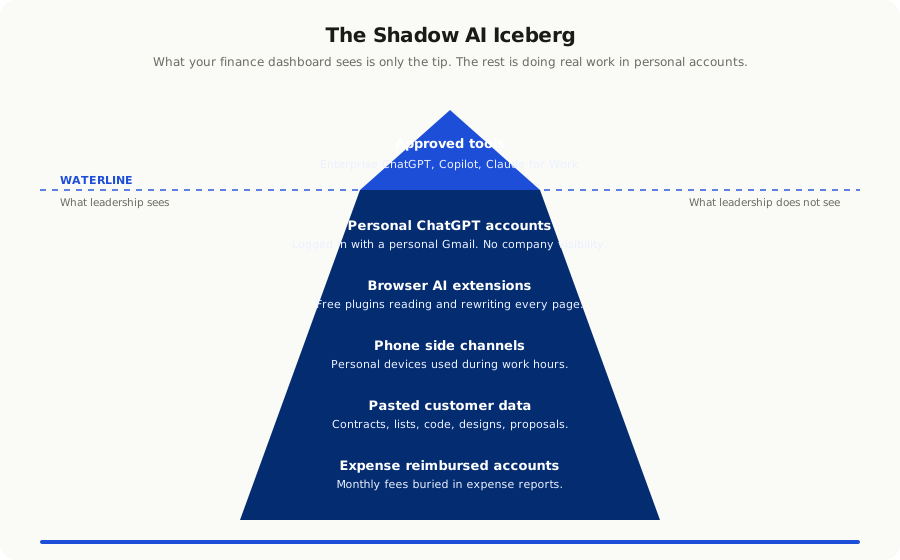
Most leaders only see the tip. The corporate ChatGPT Enterprise account that finance approved last year shows up in the budget. The Copilot license that the engineering team uses shows up in the dev tools bill. Everything below the surface, the personal accounts, the browser extensions, the side phones, is invisible until something goes wrong.
Why It Happens, Even in Strict Companies
The instinct is to blame the employee. The employee saw the rule, broke the rule, and put the company at risk. That story is not wrong, but it is not useful. If you stop there, you will spend the next year writing stricter rules that get broken faster. The better question is why a smart, well meaning employee chose the model over the policy.
The honest answer is that the model makes them better at their job in a way nothing else does. The sales rep writes a proposal in twenty minutes instead of six hours. The marketing manager rewrites a campaign brief in five drafts before lunch. The support lead summarizes a long thread into three sentences for the next shift. The accountant turns a messy email into a clean invoice draft. The developer turns a vague bug report into a useful patch. Every one of those wins is real, and every one of them is felt by the worker the moment it happens.
The policy, on the other hand, is felt as a tax. The internal AI tool, if there is one, often runs on an older model and a slower interface. The approval process to use a new model takes weeks. The training requires a slide deck nobody finishes. So the worker reaches for the tool that works in two clicks and ignores the rule that adds twenty.
This is not a story about discipline. It is a story about a missing product. If your internal AI option is worse than the public one, your people will use the public one. They will tell themselves it is fine. They will be careful. They will not paste in the worst data. Until one day, under deadline pressure, they will.
The companies that handle this well stop trying to lower the demand and start trying to meet it. The companies that handle it badly keep writing emails about the rules.
The Five Risks That Show Up Later
Shadow AI does not blow up on day one. It compounds quietly. By the time the first incident hits a board meeting, the trail goes back a year or more. Here are the five risks that always show up, in roughly the order they appear.
**Data exposure.** This is the one most leaders worry about, and they are right to. When an employee pastes a customer list, a contract, a financial model, a code base, or a draft strategy document into a public model, that data leaves the company's control. Even when the model provider says they do not train on customer chats, the data is still sitting on a server you do not own, in an account that may be tied to a personal email, behind a password the worker reuses on six other sites. The risk is not just that a model trains on it. The risk is that one breach, one stolen laptop, one phishing attack on a personal Gmail, exposes a year of work.
**Intellectual property confusion.** When a worker pastes your company's source code or design or copy into a model and asks the model to revise it, the line between what your company created and what the model generated becomes hard to draw. If a competitor later releases something similar, you will have a harder time arguing it was yours. Some courts in 2025 already started looking at this. The legal picture is still messy, and your contracts with customers may not protect content that was reshaped by a model your company never approved.
**Compliance and regulatory breach.** If you handle health records, payment data, personal information under privacy law, or any other regulated data, pasting it into a public model is a breach. It does not matter that nothing visibly bad happened. The act of sending the data to an unapproved third party is the breach. Auditors do not need an incident. They need only proof that it happened. In 2026 several regulators in Europe and the United States started asking for AI usage logs the same way they ask for access logs. Companies that cannot produce them are starting to lose contracts.
**Accuracy debt.** Models make confident mistakes. A worker who pastes a tax form into a model and trusts the answer is taking on a quiet kind of debt. The output looks right. It is signed off. It is sent to the client. Months later, a small error in a calculation surfaces, and the company has to retrace where it came from. Without a record of which model was used, which prompt was used, and what data was fed in, the team cannot reproduce the error, cannot fix the pattern, and cannot prevent the next one. This is the risk that grows the most over time.
**Billing chaos.** This sounds small and is not. As AI usage spreads, costs leak in odd places. Personal accounts get reimbursed on expense reports. Browser extensions charge monthly fees. Team plans for one tool sit next to enterprise plans for another. Two departments pay for the same model at two different rates. Finance has no clean view, security has no clean view, and the total bill grows by a third every quarter without anyone able to explain why.
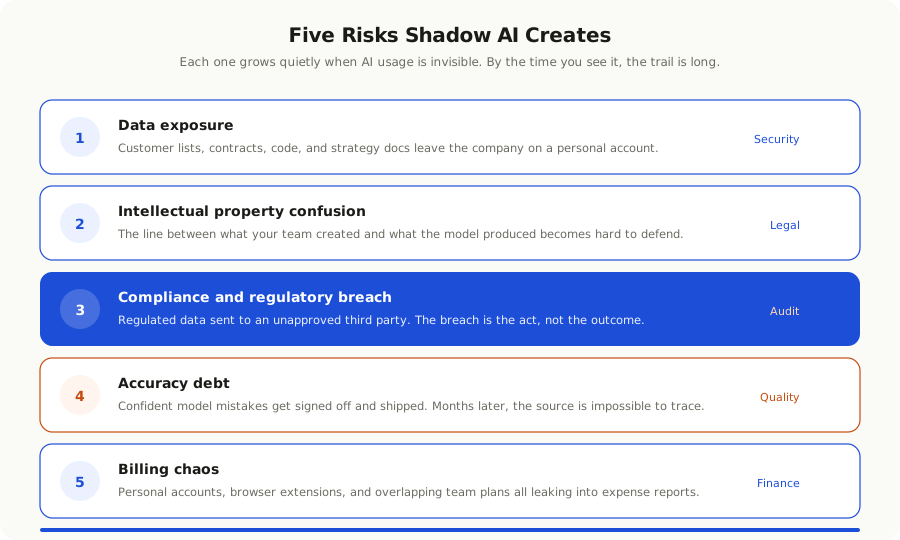
These risks do not need a disaster to hurt you. They show up as small inefficiencies, missed audits, and slow leaks of value. By the time the board notices, the cleanup is much larger than the prevention would have been.
Why Bans Backfire
The most common reaction, once a leader hears that shadow AI is happening, is to ban it. Lock down the tools. Block the URLs at the firewall. Write a stricter policy and have everyone sign it again. This almost never works, and the reason it does not is worth understanding.
A ban does not lower the demand. It lowers the visibility. The worker who used to type into a tab on a company laptop now types into the same tab on a personal phone. The data still leaves. The output still gets pasted back into the worker's email. The only difference is that the company can no longer see any of it. Your audit log gets shorter. Your risk does not.
A ban also creates a culture of quiet rule breaking. Smart workers know the rule is not workable. They do their job the way that gets results. The next time you write a rule, they trust it less. The policy slowly loses the ability to shape behavior at all.
There is also the speed cost. A team that cannot use the best tool falls behind a team that can. If your competitors let their people use AI well and you do not, you lose talent, you lose deals, and you lose the compounding gains that come from working faster every quarter. The ban that was meant to protect the company starts to weigh it down.
The point of a policy is not to stop the work. The point is to shape the work so the company can see it, learn from it, and protect itself while it happens.
The companies that have done this well are not the ones with the strictest rules. They are the ones who treated AI like every other powerful tool a company adopts. Internet access. Email. Cloud storage. Each of those was once feared and banned. Each of those is now wired into how every company runs. AI is on the same road. The companies that build a sensible policy now, while the patterns are still forming, will end up with a tool that gives them an edge. The companies that wait will spend the next three years trying to clean up.
What a Sensible Shadow AI Policy Looks Like
A good policy has four parts. None of them are dramatic. All of them are honest about how people actually work.
**A blessed tool.** The first job of any policy is to give the worker a default that is at least as good as the public option. This usually means a paid enterprise account with a current model, a clean interface, and proper logging. ChatGPT Enterprise, Claude for Work, Microsoft Copilot, or a custom deployment behind your own keys all qualify. What matters is that a worker can open the tool, get the same quality of output they would get from a personal account, and know that the company has them covered. If your internal tool is worse, your policy is dead on arrival.
**A short, plain list of yes and no.** A policy that runs to fifteen pages will not be read. A policy that fits on one page will. The yes side lists the kinds of tasks the company supports. Drafting proposals. Summarizing meetings. Writing code with review. Generating images for internal slides. The no side lists the kinds of data that must never go into any model, blessed or not. Customer health data. Payment card numbers. Source code for regulated systems. Anything that would make a regulator wince. The line should be drawn so clearly that a worker under deadline pressure can see it without having to read a manual.
**A safe place to ask.** Every policy needs an obvious channel for the gray area. A Slack channel. A small team email. A regular office hour. When a worker is not sure whether a task is allowed, they should be able to ask in two minutes and get a clear yes or no. If the only way to ask is a ticket queue with a five day SLA, the worker will just guess, and the guess will often be wrong.
**A light audit, not a heavy one.** Logging matters because of the audit risk above. But the goal is not to spy on individual workers. The goal is to know, at the level of the team or the function, what kinds of data are flowing through which tools. Most enterprise plans now expose this. A monthly review by IT or security, looking at usage trends and any high risk patterns, is enough for most companies. The lighter the audit feels to the worker, the more likely the worker is to use the blessed tool instead of going around it.
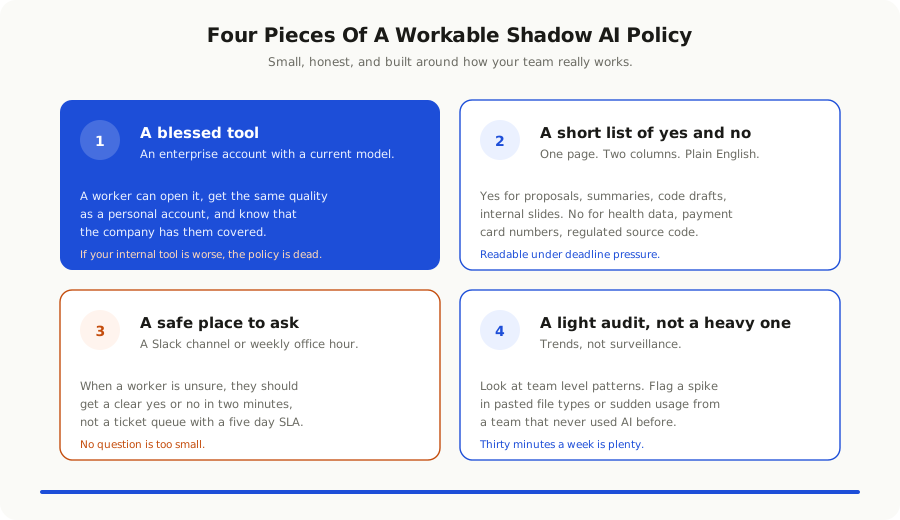
The policy works because it accepts that AI is now part of the job. It does not try to push the worker back into a slower way of working. It moves the worker into a faster way that the company can see and protect.
A Practical Thirty Day Rollout
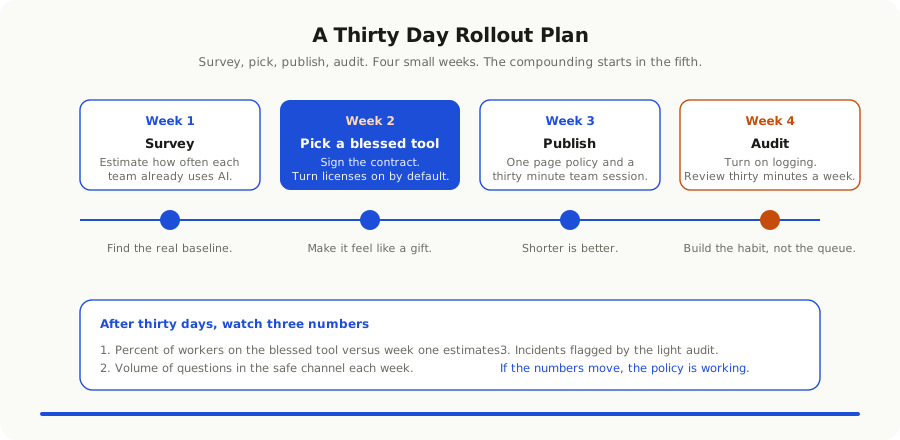
You do not need a year to fix this. You need a month and a small team. Here is the version that has worked in companies between fifty and two thousand people.
In the first week, run a quiet survey. Ask every team to estimate how often they use any AI tool in a typical week, on a personal account, a company account, or both. Promise that the survey is for planning, not for discipline. The number will surprise you. Most companies discover that between forty and seventy percent of their knowledge workers already use AI daily, and a clear majority of that is on personal accounts. Treat this as a baseline, not a problem.
In the second week, pick a blessed tool. The choice is less important than the speed. Most companies pick one main model with proper enterprise terms, plus a coding assistant for engineering. Get the contract signed. Roll out licenses to the teams that already use AI heavily. Make the rollout feel like a gift, not a crackdown. Worker access should be on by default, not on request.
In the third week, publish the one page policy. Include the yes list, the no list, the safe place to ask, and a short note about logging. Run a thirty minute live session for each function to walk through it. Take questions. Update the policy based on what you hear. Resist the urge to add length. The shorter it is, the more it will be followed.
In the fourth week, set up the light audit. Turn on the logging that the enterprise tools already offer. Define three or four patterns that should trigger a quiet review, such as repeated pasting of certain file types or sudden spikes in usage from a team that never used AI before. Assign one person to look at the dashboard for thirty minutes a week. Build the habit, not the bureaucracy.
After the month, look at three numbers. The percentage of workers on the blessed tool versus their estimated personal use from week one. The number of policy questions in the safe channel, which should be high in week one and lower by week six as the team learns the rules. The number of incidents found through the light audit, which should be small and falling.
If the numbers move, you have a working policy. If they do not, the most common cause is that the blessed tool is worse than the public option. Fix that first. Everything else follows.
The Bigger Picture
Shadow AI is not really a problem about AI. It is a problem about the gap between the speed of new tools and the speed of corporate process. The gap has always existed. It was there with email, the cloud, mobile phones, and Slack. Each time, the workers got the better tool first and the company caught up later. The cost of catching up was always smaller when the company moved early and bigger when it waited.
AI is the same shape with a sharper curve. The tools get better every few months. The gap between the worker's personal stack and the company's official stack grows every week unless someone is actively closing it. A leader who builds the habit of closing the gap now will build a company that absorbs the next tool faster, and the one after that.
There is also a quieter benefit that almost no one talks about. When you give your team a blessed AI tool with clean logging, you start to learn something you never knew before. You see what kinds of work your team actually does. You see which tasks could be automated, which prompts the team repeats every day, which knowledge lives in nobody's head and could be captured. The logs become a map of the company's real workflows, drawn by the workers themselves. Smart leaders use that map to design better internal tools, better training, and better products.
The teams that get this right in 2026 are not the ones with the strictest rules. They are the ones who treat AI like fire. Useful, dangerous, worth respecting, worth using every day, and never to be locked in a cabinet with a sign that says do not touch.
Shadow AI will not go away by being banned. It will move out of the shadows the moment you build a place worth standing in. That place is a sensible policy, a tool that does not embarrass itself next to the public option, and a culture that trusts the worker to do the right thing once you have made the right thing easy.
The work starts small. Survey this week. Pick a tool next week. Publish a one page policy the week after. By the end of next month, the conversation in your company will have changed. The worker who used to hide a useful tool will use it openly. The leader who used to fear an incident will see the work as it happens. The compliance team will have logs to show. The board will have a story to tell.
If you want to go deeper into the technical and data side of this, our notes on [why your data is not ready for AI](/blog/why-your-data-isnt-ready-for-ai-and-what-to-fix-first) and [how AI is reshaping custom software](/blog/how-ai-is-reshaping-custom-software-development) cover the foundations that a good AI policy sits on top of. Together, they are how teams in 2026 are moving from secret tools to working systems.