A founder calls you on a Monday morning. They have signed up for an AI platform, picked a use case, and set a launch date for the end of the quarter. They want to know how soon their team can start building. You ask one question. Where does the data live, and who owns it?
There is a long pause.
This is the most common scene in business AI in 2026. The tools are ready. The models are ready. The budgets are ready. The data is not. Most companies discover this only after they have spent money, hired help, and missed a deadline.
This post explains, in plain English, what it means for data to be ready for AI, the five problems that keep most teams stuck, the costs nobody puts in the proposal, and a sensible order of work to fix it. If you are about to start an AI project, read this first. It will save you months.
What "AI Ready Data" Actually Means
When people say their data is ready for AI, they usually mean one of two things. The simple version: a model can read the data and produce something useful from it. The full version: the data is clean enough, complete enough, well labelled enough, and accessible enough that an AI system can rely on it without producing nonsense or causing legal trouble.
Both versions matter, but the full version is the one that decides whether your project succeeds or quietly dies.
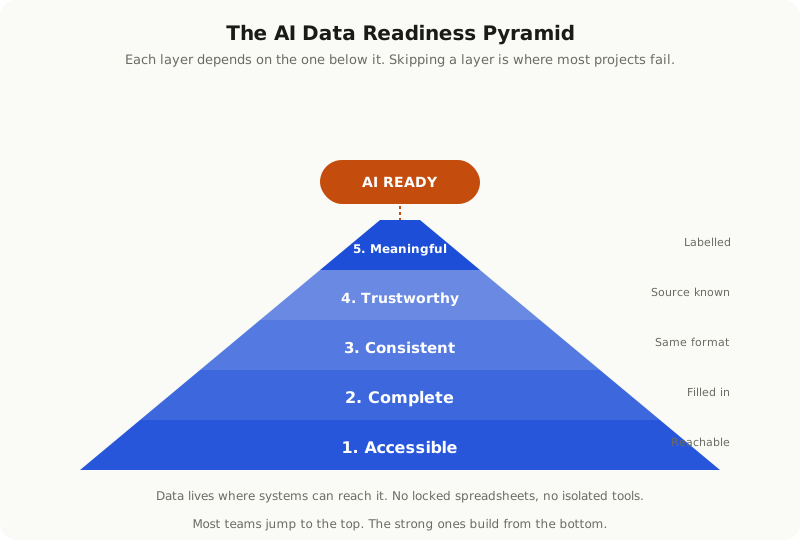
You can think of AI readiness as a stack. Each layer has to hold before the next one matters.
**Accessible.** The data exists in a place a system can reach. Not on someone's laptop. Not in a spreadsheet only Suresh has the password to. Not locked inside a tool that does not allow exports.
**Complete.** The fields you need are filled in for most records. A customer table with phone numbers missing for forty percent of rows is not complete data, even if the table looks impressive.
**Consistent.** The same thing is recorded the same way. "Mumbai" and "MUMBAI" and "mumbai" are three different cities to a computer until someone teaches it otherwise.
**Trustworthy.** Someone can vouch for where the data came from, when it was last updated, and what it means. If nobody can answer those questions, the data is not trustworthy.
**Meaningful.** The data is labelled or structured so a model can use it. A folder of ten thousand PDFs is data. A folder of ten thousand PDFs tagged by document type, customer, and date is meaningful data.
A useful test before any AI project: can you describe each of these layers for the data you plan to use? If you cannot, the project is not ready to start. The build comes later.
The Five Problems That Block Most Teams
Across hundreds of conversations with founders and operations leaders, the same five problems show up again and again. They are not exotic. They are boring, ordinary, and very expensive.
Problem 1: Data Is Scattered Across Tools
A typical mid sized company in 2026 runs on twenty to forty different tools. CRM, support desk, billing, accounting, email, calendar, spreadsheet, project tracker, file storage, analytics, and a long tail of single use apps. Each tool has its own copy of related information.
The customer record in the CRM does not match the customer record in the billing system. The product catalogue in the website does not match the one in the warehouse software. When you ask your AI to "look up a customer," you have to first decide which of the five places counts as the truth.
Most teams have never sat down and drawn this map. Until they do, every AI project starts with an unplanned data integration project.
Problem 2: The Same Thing Is Written Five Different Ways
Data entered by humans drifts. One sales rep types "Pvt Ltd" and another types "Private Limited" and a third types "P. Ltd." All three mean the same company. To a model, they are three different ones.
This shows up in customer names, city names, product codes, currency formats, date formats, and almost every free text field. The cost of the inconsistency is invisible until a model tries to count things, match things, or make a decision based on what it reads.
Problem 3: Critical Information Is Stuck in Documents
A huge amount of business knowledge lives in PDFs, scanned forms, contracts, presentations, and emails. None of it is structured. Most of it has no metadata beyond a filename. Some of it is locked behind logins and inboxes nobody monitors.
This is the single biggest unexplored area for AI in business. It is also the one most likely to leak sensitive information if handled badly. Document data needs work before any model touches it, and that work is rarely budgeted for.
Problem 4: Nobody Knows Who Owns the Data
Ask a simple question. Who decides what counts as a valid customer record? In most companies, the answer is some combination of "sales," "operations," "accounts," and a long pause. There is no single person whose job is to keep the customer list correct.
When data has no owner, two things happen. Quality drifts because nobody is responsible for it. And when an AI project hits a question about the data, there is no one to ask, so decisions get made by whoever is loudest in the meeting.
Problem 5: The Data Has Privacy and Compliance Strings Attached
Indian DPDP, European GDPR, payment data under PCI, health data under HIPAA. Different rules, different regions, same effect. Some of your data cannot be sent to a model hosted outside a particular country. Some of it cannot be used to train a model at all. Some of it requires a specific consent record before it can be processed.
Most teams discover these rules in the middle of a project. By then, decisions have already been made that have to be unmade. The right time to know what your data can and cannot do is before you start.
The Hidden Costs Nobody Puts in the Proposal
When an AI project goes over budget or misses its deadline, the public reasons are usually about the model or the tooling. The real reasons are almost always about the data.
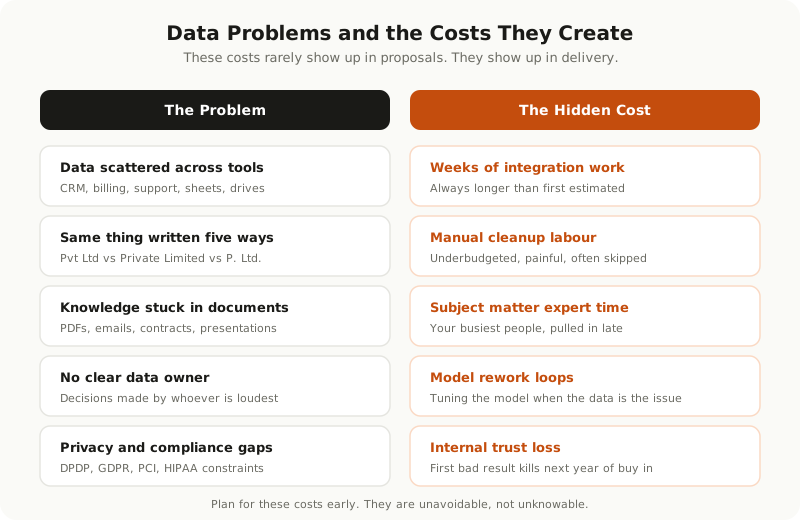
**Integration time.** Connecting your tools to a single working pipeline takes weeks, sometimes months. This work is unglamorous, hard to estimate, and skipped over in most early proposals.
**Cleanup labour.** Somebody has to actually fix the inconsistencies. Standardise the city names. Merge the duplicate customers. Fill in the missing fields where it is possible to do so safely. This work is often underbudgeted because it looks simple from the outside and turns out to be a swamp.
**Subject matter time.** Your senior people are the only ones who know which records are correct, which exceptions are real, and what the messy fields actually mean. They are also the busiest people you have. The cost of pulling them into data work is real, even if it is not on an invoice.
**Model rework.** When a model is built on weak data, the first version disappoints. You then spend time tuning the model when the actual problem is upstream. Many teams go round this loop two or three times before they accept that the data has to be fixed first.
**Trust loss inside the company.** This is the one that hurts the most. If the first AI project produces wrong answers, your team stops trusting AI for the next year. Getting that trust back is harder than getting it the first time.
None of these costs are unavoidable. They just need to be planned for.
How to Audit Your Data Readiness Before You Build
Before anyone writes a line of code, run a simple audit. You do not need a consultant for this. You need a focused day with the right people in the room.
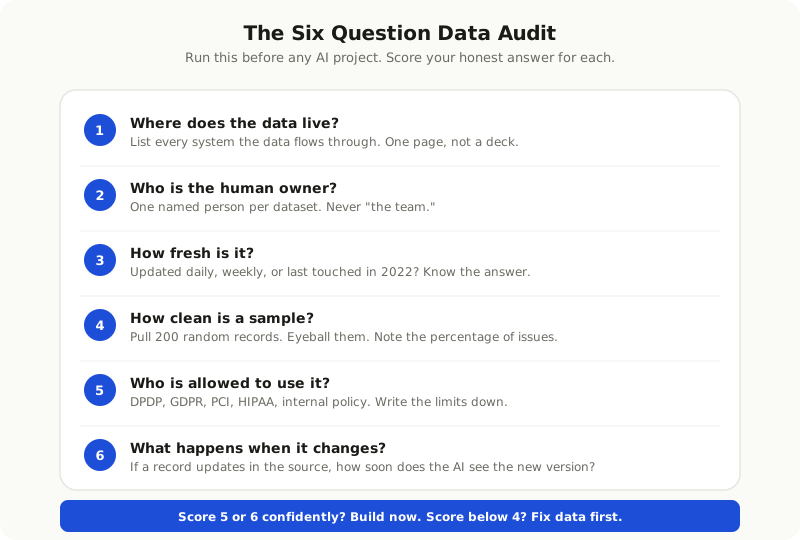
Pick the specific use case you want AI to solve. Not "customer experience." Something narrow, like "answer order status questions automatically" or "summarise weekly sales for the leadership team." Then ask these questions about the data that use case will touch.
**Where does the data live?** List every system the data flows through. If you cannot list them on a single page, that is a finding.
**Who is the human owner?** One named person for each dataset. If the answer is "the team," that is the wrong answer. Pick a person.
**How fresh is it?** Some data is updated every minute. Some has not been touched since 2022. Both can be useful. Mistaking one for the other is dangerous.
**How clean is a sample?** Pull two hundred random records. Look at them by eye. How many have missing fields, wrong values, or formatting differences? That percentage is your starting baseline.
**Who is allowed to use it?** For each dataset, write down the legal and policy constraints. If you do not know, that is a project on its own before anything else can move.
**What happens when it changes?** If a record is updated in the source system, how long until the AI sees the new version? If the answer is "we have not thought about that," you have a real time problem to solve.
The output of this audit is not a spreadsheet. It is a one page document that tells the truth about your data for this use case. Anyone who has read the document should be able to estimate the size of the cleanup ahead.
A Sensible Order of Work
Once you know where you stand, fix things in the order that matters. Most teams try to do everything at once and run out of energy. The teams that succeed do this in stages.
**Stage 1: Pick one use case and one dataset.** Do not try to clean the whole company. Pick one job for the AI to do and the smallest set of data that makes it possible. Customer support resolution. Lead qualification. Internal knowledge search. Pick one.
**Stage 2: Define what good looks like.** Write a one paragraph description of what a clean record looks like, with three real examples. This document is the single source of truth for the cleanup. Without it, every team member will clean things slightly differently.
**Stage 3: Centralise before you clean.** Move the data into a place where one team can work on it. A data warehouse, a clean database, or a single curated spreadsheet for small projects. Cleaning data while it is still scattered across five tools is futile.
**Stage 4: Clean the highest value fields first.** For your chosen use case, three or four fields will matter most. The customer phone number for support. The product SKU for inventory. The deal stage for sales forecasting. Fix those first. Leave the rest for later.
**Stage 5: Add governance as you go.** Every cleaned dataset gets an owner, a freshness target, a quality check, and a documented process for updates. This is not glamorous, but it is what stops the data from drifting back to its old state in six months.
**Stage 6: Now build the AI.** With clean, owned, governed, accessible data covering one focused use case, you can finally pilot the AI. Measure the result against the previous way of doing things. Improve. Expand to the next use case using the foundation you built.
This sequence is not exciting. It is also the only one that has a reliable record of working.
When You Are Actually Ready to Start
There is a clear point where you stop preparing and start building. Use this short readiness check before kicking off any AI project.
You can describe the use case in one sentence, and the data the AI will need in three to five bullets.
You know which systems the data lives in, and you have at least one connected pipeline that can pull from each.
You have a named owner for every dataset, and that person knows they are the owner.
You have agreed on what a clean record looks like, and a sample audit shows the data is at least eighty percent there for the chosen use case.
You know the legal limits on the data, and your AI plan respects them.
You have a way to measure whether the AI is actually doing better than the current process.
If all six are true, you can build with confidence. If any are missing, fix them first. The build will go faster on a better foundation than it ever will on a shaky one.
A Practical First Step You Can Take This Week
You do not need a six month strategy to make progress. Pick one process in your business that costs your team time every week, and do these three things in the next seven days.
Map every system that touches the data for that process on a single page. Note who owns each one.
Pull two hundred real records, by hand, from each system, and grade them by eye. Note the most common problems.
Write a one paragraph description of what a clean record should look like, with three correct examples.
By the end of the week, you will know more about your data than ninety percent of companies your size. You will also know exactly what has to happen before AI can help. That is the real starting line, not the day you sign with a vendor.
AI is going to change how every business works in the next few years. The companies that get there first will not be the ones with the biggest model budget or the loudest pilot programme. They will be the ones who took data seriously while everyone else was chasing the demo. The good news is that this work pays back even before the AI arrives, because clean, owned, accessible data makes every part of your business easier to run. Start there. The rest gets much easier once you do.