Picture a meeting room last quarter. A small team stands at the front with a laptop plugged into the big screen. They type a question. The AI reads a stack of company documents, thinks for a second, and writes back a clear, correct answer. The room goes quiet, then someone says the words every team wants to hear. "This changes everything. Let's roll it out."
Six months later, nothing has rolled out. The demo still works if you ask the same person to run it. But no real customer has touched it. No team uses it every day. The project is not dead on paper. It is just stuck, sitting in a slide deck, waiting for a launch date that keeps slipping.
This is the AI pilot trap, and in 2026 it is everywhere. Companies are not short of AI ideas. They are short of AI features that actually reach users. This post explains why pilots look so good and ship so rarely, where they quietly die, and how to run a pilot that finishes the journey. It is written for founders, product leaders, and operations managers, not for researchers. No machine learning background needed.
What the AI Pilot Trap Really Is
A pilot is meant to be a small test. You build a quick version of an idea, try it on a real problem, and learn whether it is worth doing for real. That is healthy. Pilots are how good teams avoid betting big on something that does not work.
The trap is different. The trap is when the pilot becomes the destination instead of the first step. The demo gets built, it impresses everyone, and then the project never moves past that moment. It does not get cancelled, because it looked promising. It does not get launched, because launching is hard. It just floats.
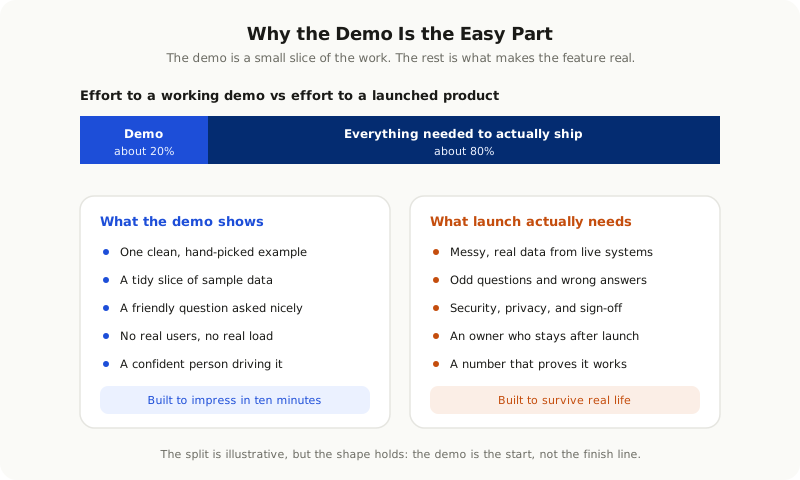
The reason this keeps happening is simple. A demo and a product feel similar, but they are not the same thing at all. A demo has to work once, in front of a friendly audience, on an example you chose. A product has to work all day, for strangers, on data you did not pick. The gap between those two things is where most of the real work lives, and most pilots never budget for it.
Why the Demo Looks So Good
It helps to understand why pilots are so easy to make impressive, because that is exactly what fools people.
Modern AI tools are very good at the first ten minutes. You can connect a model to a few documents and get a working answer in an afternoon. The technology that used to take a research team now takes one developer and a free trial. That is genuinely new, and it is wonderful.
But that same speed creates a false signal. The team builds the demo fast, so leadership assumes the whole project will be fast. The demo answers one question well, so everyone assumes it will answer every question well. The demo runs smoothly, so nobody asks what happens when it does not.
The demo is built to remove friction. The presenter picks a clean example. They pick a clear question. They pick data that is tidy and complete. They run it on a calm laptop with nobody else online. Every one of those choices makes the demo look finished when it is really just started. The demo is the marketing for the project. It is not the project.
Where AI Pilots Quietly Die
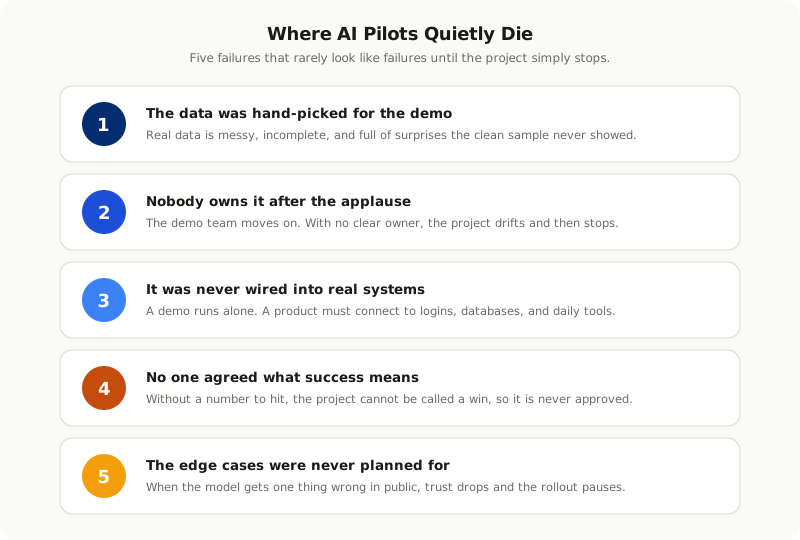
When you look at pilots that stalled, the same five causes show up again and again. None of them feels like a disaster on the day it happens. Together, they end the project.
The Data Was Hand-Picked for the Demo
This is the most common killer. The demo ran on a small, clean set of documents that someone chose because they were neat. Real company data is not neat. It has duplicates, old versions, missing fields, scanned images, and three spreadsheets that disagree with each other. When the pilot meets real data, the answers get worse, and the team is surprised. They should not be. The demo never tested the hard part.
Nobody Owns It After the Applause
A pilot is often built by a side team or an outside group brought in to show what is possible. The demo ends, they get praise, and they move to the next thing. Now the project has no owner. No single person wakes up responsible for it. Work that has no owner does not fail loudly. It just slows down, then stops, and nobody can say exactly when.
It Was Never Wired Into Real Systems
A demo runs on its own. A real feature has to live inside the tools people already use. It needs to respect logins and permissions. It needs to read the live database, not a copy from last month. It needs to fit into the screen where the work actually happens. Connecting all of that is real engineering, and it is usually larger than the AI part itself. Pilots that skip this step have built a toy, not a feature.
No One Agreed What Success Means
Ask a stalled pilot team a simple question. What number would prove this works? Very often they cannot answer. The pilot was approved because it was exciting, not because it had a target. Without a target, the project can never be declared a win. And a project that can never be declared a win can never be approved for full launch. It is trapped by its own lack of a finish line.
The Edge Cases Were Never Planned For
The demo only shows the happy path. The model gets the easy question and gives a good answer. Real users do not stay on the happy path. They ask strange questions. They paste in odd files. They find the one case where the model is confidently wrong. The first time that happens in front of a customer, trust drops fast. If the team never planned for wrong answers, slow answers, or "I am not sure" answers, the rollout pauses the moment something goes wrong.
The simplest test for a pilot is this. If the only person who can run it is the person who built it, you do not have a product. You have a magic trick.
The Gap Nobody Budgets For
Step back and the pattern is clear. The pilot trap is not really an AI problem. It is a planning problem.
Teams budget time and money for the part they can see, which is the demo. They do not budget for the part they cannot see, which is everything that turns a demo into a feature people trust. Real data handling. System connections. Security review. Error handling. Training for the people who will use it. A way to measure if it is helping.
That hidden work is usually the bigger half of the job. When it is not planned, it does not get done. And when it does not get done, the pilot sits exactly where the applause left it.
There is also a quieter cost. Every stalled pilot teaches the company a small, wrong lesson. People start to believe that AI is all show and no delivery. The next good idea gets a colder welcome. A few dead pilots can slow down a whole company's appetite for change, even when the ideas were sound.
How to Run a Pilot That Actually Ships
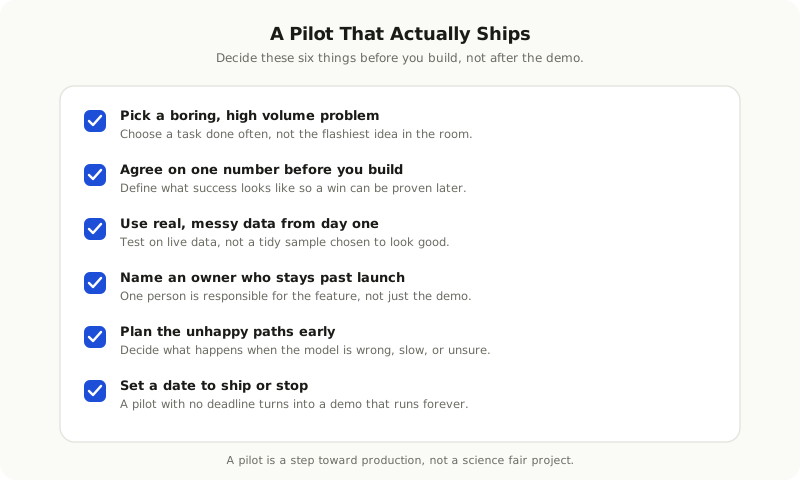
The good news is that the fix is not complicated. It is mostly about deciding a few things before you build, instead of after the demo. Here is what a pilot that reaches production does differently.
Pick a Boring Problem on Purpose
The flashiest idea is rarely the best first pilot. Pick a task that is done often, follows clear rules, and has an obvious right answer. Sorting support tickets. Pulling key facts out of forms. Drafting a first reply that a human checks. Boring problems are easier to measure, easier to launch, and easier to trust. A boring pilot that ships beats an exciting pilot that floats.
Agree on One Number Before You Build
Before a line of code is written, write down what success looks like. It should be a single, plain number. Cut average handling time by twenty percent. Answer eight out of ten questions correctly without a human. Save each agent thirty minutes a day. With a number, the pilot can be judged. Without one, it can only be admired.
Use Real, Messy Data From Day One
Do not save the hard data for later. Start the pilot on real, live, imperfect data, even if the early results look worse. It is far better to see the true picture in week one than to be shocked in month four. The messy data is not a problem to avoid. It is the actual test.
Name an Owner Who Stays Past Launch
Pick one person who is responsible for this feature reaching real users and working well after that. Not a committee. Not the team that built the demo and then left. One named owner with the time and the authority to push it forward. Projects with an owner move. Projects without one drift.
Plan the Unhappy Paths Early
Decide, on purpose, what happens when things go wrong. What does the user see when the model is unsure? How does a person step in and fix a bad answer? How do you spot when quality is slipping? Designing for the wrong answer is what makes users trust the feature when it is right. Skip this and your first public mistake becomes your last.
Set a Date to Ship or Stop
Give the pilot a real deadline. By this date, it either goes live to a first group of real users, or it is parked with a clear reason. A pilot with no deadline is not a pilot. It is a demo that has been allowed to run forever. The deadline forces the hidden work to get planned.
When to Push Forward and When to Stop
Not every pilot should ship, and that is fine. The point is to make a clear choice instead of letting the project fade.
Push forward when the pilot hit its number on real data, when a named owner is ready, and when the path to connect it into your systems is understood, even if it is hard work. Hard is fine. Hard is normal. Unclear is the warning sign.
Stop, or pause, when the pilot only works on hand-picked examples, when nobody can say what number it should hit, or when the real version would cost far more than the value it returns. Stopping with a clear reason is a healthy outcome. You learned something real and you freed the team for a better bet. A clean stop is a success. A slow, silent fade is the only true failure.
A Sensible Way to Think About All of This
AI pilots are not failing because the technology is weak. The technology is the strongest it has ever been. They are failing because teams treat the demo as the win, when the demo is only the invitation.
The companies pulling ahead in 2026 are not the ones with the most pilots. They are the ones with the most pilots that actually reached users. They got there by being honest about the gap between a demo and a product, by planning the hidden work, by naming owners, and by setting a number and a date before anyone got excited.
If your company has a pilot sitting in a slide deck right now, looking great and going nowhere, that is not a lost cause. It is a project that skipped a few planning steps. Pick the owner. Pick the number. Pick the date. Point it at real data. The distance from a stuck demo to a shipped feature is shorter than it looks. It is mostly a matter of deciding to finish.