Your sales team is using a spreadsheet to track leads. Your operations team just downloaded their fifth different project management tool. Your finance director is asking why you are paying for software that nobody uses anymore.
At some point, every growing business hits the same crossroads: keep piecing things together from existing tools, buy a packaged software product, or build something custom from scratch?
Each option has a place. Each one also has a way of going badly wrong when chosen for the wrong reasons. The businesses that get this decision right are the ones that understand what they are actually choosing between, not just the upfront price tag.
This guide walks through the three options clearly, explains when each one makes sense, and gives you a practical framework for making the call.
The Three Options, Defined Simply
Before comparing them, it helps to be precise about what each option actually means.
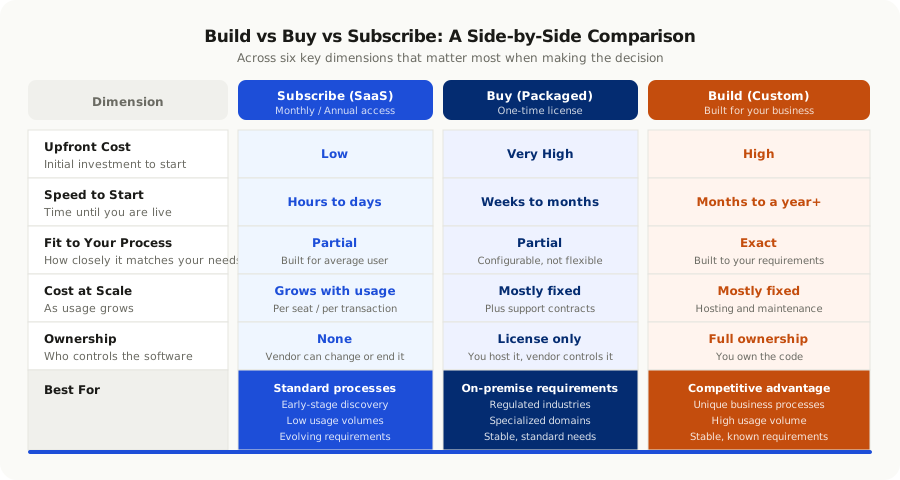
**Build** means commissioning custom software designed and developed specifically for your business. This could be a web application, a mobile app, an internal tool, or an entire platform. It does not exist before you build it. It will work exactly the way your business needs it to work, because it was built to your requirements.
**Buy** means purchasing a packaged software product, usually a one-time license or a perpetual installation, that another company built for a general market. ERP systems, accounting software, or HR platforms sold as installed software fit this model. You get the software as-is, with some configuration options but no ability to change how it fundamentally works.
**Subscribe** means paying for access to a cloud-based software service, usually monthly or annually. Most business software today uses this model: your CRM, your project management tool, your design software, your communication platform. You do not own the software. You rent access to it. The vendor maintains it, updates it, and charges you as long as you use it.
Many businesses use all three across different parts of the operation. The decision is not one-size-fits-all for an entire organization, but it applies clearly to each specific function or problem you are trying to address.
When Subscribing to SaaS Makes Sense
Subscribing to a SaaS product is usually the right starting point. For most business functions, it is faster, cheaper, and lower-risk than any alternative, at least at first.
It fits a well-understood, standard process
If your need is something that thousands of other businesses also need, a SaaS product built for that use case is almost certainly good enough. Email marketing, customer support ticketing, accounting, payroll, video conferencing, file storage: these are solved problems. A well-established SaaS product will handle them better than anything you could build in a reasonable timeframe.
You need to move fast
SaaS tools can be running in hours. Custom development takes weeks or months at minimum. If you need something working now, subscribing wins almost every time on speed alone.
Your needs are likely to change
When you are early in building a business or a new function, you do not fully know what you need yet. SaaS tools let you start using something immediately, learn from real experience, and switch to a different tool or a custom solution once you understand the requirements more clearly. Building custom software before you know exactly what you need is an expensive way to discover your requirements.
When to be careful with SaaS
The main risk with SaaS is not the subscription itself, it is accumulation. Most companies that have been running for a few years are paying for far more SaaS tools than they realize, many of which overlap, integrate poorly with each other, and nobody actually monitors. If your team's work relies on moving data between five different SaaS platforms by hand every day, the inefficiency often costs more than a custom solution would.
The second risk is that SaaS products are built for the average user. If your business process is meaningfully different from the average, you will spend significant time working around the tool's limitations rather than using it for what it does well.
A useful rule: SaaS makes sense when the process you are automating is standard, when you are learning what you need, or when the volume of use does not yet justify a larger investment. When the tool starts fighting your process instead of supporting it, that is the signal to consider a different option.
When Buying Packaged Software Makes Sense
Buying a packaged software product occupies a smaller space in the modern landscape than it used to. Most enterprise software has moved to a subscription model. But there are still situations where a purchased, licensed product makes sense.
High compliance or security requirements
Some industries and regulatory environments require software to be hosted on your own infrastructure, with specific security controls you cannot get from a cloud-hosted SaaS tool. Healthcare, finance, and government sectors sometimes fall into this category. A licensed, on-premise product gives you the control you need without the cost and time of building from scratch.
Large-scale ERP or core infrastructure systems
Major ERP platforms, manufacturing execution systems, and some supply chain management products are still commonly sold as purchased licenses with implementation services. These systems are enormous and represent decades of accumulated domain expertise. No custom development project can replicate them cost-effectively.
Stable, mature requirements with no differentiation needed
If your business process for the area in question is completely standard and unlikely to change, and you need something robust and well-tested, a licensed packaged product can be a strong choice. The risk is that these products often require significant implementation and configuration work, and that work can cost more than the license itself.
When Building Custom Software Makes Sense
Building custom software is often described as expensive. It is more accurate to say it is an investment that pays off strongly in some situations and poorly in others.
The software IS your competitive advantage
If what you are building is the product itself, or a core internal capability that directly differentiates you from competitors, then custom software is almost always the right answer. You cannot build a unique, defensible product on top of tools that every competitor also has access to.
For a technology company, this is obvious. But it also applies to non-tech businesses: a logistics company whose routing algorithm is more efficient than competitors', a financial services firm whose risk modeling is proprietary, a retailer whose inventory management is a genuine edge. In all these cases, the software is the competitive advantage. Subscribing to off-the-shelf tools means sharing your advantage with everyone else.
You have processes that cannot fit into standard tools
When your business model is unusual enough that standard software requires constant workarounds, the workarounds eventually cost more than custom development would have. The warning signs are teams spending hours moving data between systems by hand, processes that require three tools where one should do, and employees who have given up trying to make the tool work and just "do it the old way."
You are integrating many systems that do not talk to each other
When a business grows to the point where it is running on a collection of SaaS tools that do not integrate cleanly, a custom integration layer or an internally built system that consolidates data and workflow can solve the problem once and permanently. This is often far cheaper over three to five years than continuing to pay for tools that sort-of-work-together.
Your volume justifies the investment
SaaS pricing scales with usage. At small volumes, paying per seat or per transaction is cheaper than building. At large volumes, the monthly SaaS bill often exceeds what a custom solution would have cost to build and maintain. Run the numbers honestly. For many mid-size to enterprise businesses, custom software reaches cost parity with SaaS within two or three years.
The Real Cost of Each Option
Most organizations only compare the upfront cost. The decision looks very different when you include the full cost over three to five years.
| Cost Category | SaaS Subscription | Packaged Product | Custom Build |
|---|---|---|---|
| Upfront cost | Low (setup, onboarding) | High (license + implementation) | High (development) |
| Ongoing cost | Monthly/annual fee, scales with usage | Maintenance and support contracts | Hosting, updates, maintenance team |
| Switching cost | Medium (data migration, retraining) | Very high (migrations are expensive) | Medium to high |
| Cost of poor fit | Hidden (workarounds, lost productivity) | High (hard to customize) | Low (built to fit) |
| Cost at scale | Grows linearly with usage | Mostly fixed | Mostly fixed after build |
The category that most organizations undercount is the cost of poor fit. When a team of fifty people spends thirty minutes each day working around a tool's limitations, that is twenty-five person-hours per day of productivity lost. Over a year, it adds up to thousands of hours. It never appears on an invoice, which is exactly why it gets overlooked.
A Four-Question Framework for Making the Decision
These four questions cut through most of the noise around software decisions. Work through them in order.
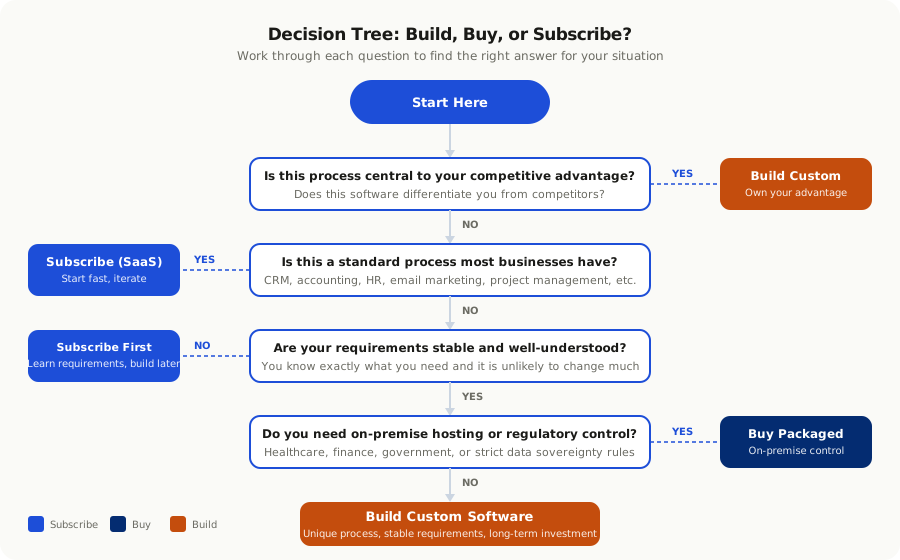
**Question 1: Is this process standard, or unique to how we work?**
If standard, start with SaaS. There is almost certainly a tool built specifically for this use case. Evaluate two or three options and choose the best fit. Only consider custom development once you have evidence that the standard options cannot serve you well.
If genuinely unique, the case for custom software is strong from the start. Unique processes rarely fit well into tools built for average use cases.
**Question 2: Is this process central to our competitive advantage?**
If yes, custom software is almost always the right choice over time, even if you start with a SaaS tool to learn the requirements. You cannot maintain a sustainable competitive advantage on a platform your competitors also use.
If no, and the process is operational rather than differentiating, SaaS or packaged software is usually the right answer. Not everything needs to be custom-built.
**Question 3: How stable are the requirements?**
If requirements are still evolving, start with SaaS. Build only when you know exactly what you are building. The most expensive custom software is custom software built to the wrong requirements.
If requirements are stable and well-understood, a custom build can be planned accurately and executed with confidence.
**Question 4: What does the five-year cost look like, honestly?**
Run an actual number. Include SaaS subscription growth (most increase prices over time), internal labor spent on workarounds, the cost of a replatforming project when the SaaS tool no longer fits, and the ongoing cost of custom development maintenance.
Many organizations discover that custom development they assumed was too expensive actually reaches cost parity with their current SaaS spend within three to four years, and saves money after that.
Common Mistakes in This Decision
**Building too early.** Building custom software before you deeply understand the requirements is one of the most reliable ways to waste a development budget. The best time to build is when you know exactly what you need and have evidence that standard tools cannot provide it.
**Subscribing too long.** The opposite mistake is continuing to pay for SaaS tools after they have clearly stopped fitting the business. The switching cost feels high, so the decision gets deferred. Meanwhile, the workarounds and the subscription fees keep accumulating.
**Underestimating integration complexity.** The hidden cost of many SaaS-heavy environments is the effort required to keep data consistent across systems. If your team is regularly exporting from one tool and importing to another, that is not a feature gap in the tools. That is a signal that the architecture of how you use technology needs to change.
**Confusing the cheapest option with the right one.** The cheapest option is the cheapest on day one. On day one thousand, the picture is often very different.
Making the Decision With Confidence
There is no single right answer to the build versus buy versus subscribe question. There is only the right answer for your specific situation, your requirements, your competitive position, and your time horizon.
The organizations that make this decision well tend to share a few habits: they are honest about the real cost of workarounds and poor fit, they distinguish between processes that are genuinely unique to them and processes that are standard across every business, and they revisit the decision periodically rather than treating it as permanent.
If you are at a decision point and are not sure which path makes sense, the clearest input usually comes from talking to someone who has seen enough of these decisions to recognize the patterns. The specifics of your situation matter, but the underlying logic applies broadly.
At Angrio, we have worked with companies that came to us certain they needed to build custom software, only for a detailed scoping conversation to reveal that a well-configured SaaS tool would serve them better for the next two years. We have also worked with companies paying for SaaS tools for years who had not realized they were a clear candidate for a custom build. The right answer is the honest one, not the one that generates the largest project.
The Bottom Line
Build when the process is central to your competitive advantage, when requirements are stable and well-understood, and when the long-term cost math favors ownership.
Subscribe when the process is standard, when requirements are still evolving, and when speed matters more than fit.
Buy packaged software when you need on-premise control, when the domain is too specialized to build economically, or when a well-established product clearly covers your requirements.
And when you are not sure, the worst thing you can do is default to whichever option is cheapest on day one without thinking through the full picture.
If you want a second opinion on a decision like this, we are happy to talk through it. No agenda, just a clear-eyed look at the options.